

Good Tuesday evening, MacroEdge Readers & Community,
We’re just about settled into the new office in Arizona, and everything is progressing wonderfully. Thank you all for your patience during this final stretch of the adjustment period. We’ll be streamlined between our Scottsdale and Wichita Falls hubs in the next few days, and I wanted to get this entire process wrapped up before the Thanksgiving holiday. Tomorrow, I’ll head over to North Texas for about a week to get things finalized and set up there, finish some 2027 prep, knock out a few discussions on the ground, and see where that lands us right before Thanksgiving.
Now on to the market side, which is what most of you are tuning in for. We are truly living through a casino/gambling speculative mania unlike any comparable period I’ve ever seen. The en masse rollout over the last few weeks of additional ways for retail investors to lever up and go for broke on futures trading platforms is completely out of control, and Robinhood is even joining in on the fun. This bizarre 2049/73/29 Ponzi-hybrid era will have an ending, or a resolution, for the ages, even though these cycles unfortunately take a long, long time relative to our modest human lifespans.

On X, I keep reading that sentiment is ‘washed out’ or bearish. That’s against a backdrop of all-time-high household allocation to equities, a record number of daily dip buyers piling into leveraged ETFs, and a near-relentless buy-the-dip mentality that has only accelerated over the period I refer to as Powell’s Valhalla (2023-2026). One of the many lessons we learned during the Powell’s Valhalla era is that we need to see how the Warsh Fed operates during this transition period. With the December rate hike now priced in at 100%, the market knows it’s coming, and we’re just a few weeks from that announcement. Interestingly enough, yields (2s and 10s) haven’t declined at all alongside oil and equity indices. That tells me much of the recent inflation input hasn’t actually been energy costs, and the bond market remains something to watch closely for the remainder of the year. With the President now visiting China, alongside Xi and Putin, I’d expect him to be feverishly checking equity markets and itching for the next batch of TACO announcements to launch at this critical point for the indices.
There’s little reason to press the throttle on bearishness or volatility exposure until these key breakdown points validate themselves. I highlighted today on X that many charts are starting to look similar (they are: SPY, DIA, IWM, etc.), which usually happens at major market turning points. In Asia, there’s been little reprieve for South Korea, and Taiwan was briefly saved by an effective ban on short selling. With this hyper-short-term bias seemingly spreading, I’d remind everyone to zoom out and observe markets on much longer timeframes, at least occasionally. From both a fundamental (valuations, internals, etc.) and a technical standpoint, zooming out typically leads to far better outcomes than the day-to-day gambling mindset permeating everything right now. Being at such key spots in the indices means waiting to verify the next direction, which those fundamentals and technicals will reveal over the next 8-16 weeks or so. As growth fears enter the market, most noticeable in oil trading closely with the Nasdaq, and with the December hike fully priced in, I remain open to a period of reprieve until the chart breakdowns validate themselves. Again, as we’ve learned over the last 3 years, this market regime has bred a once-in-a-lifetime buy-the-dip crowd in domestic equities across the board. That also means it will ignore the most obvious warning signs when they do arrive, like the one below:
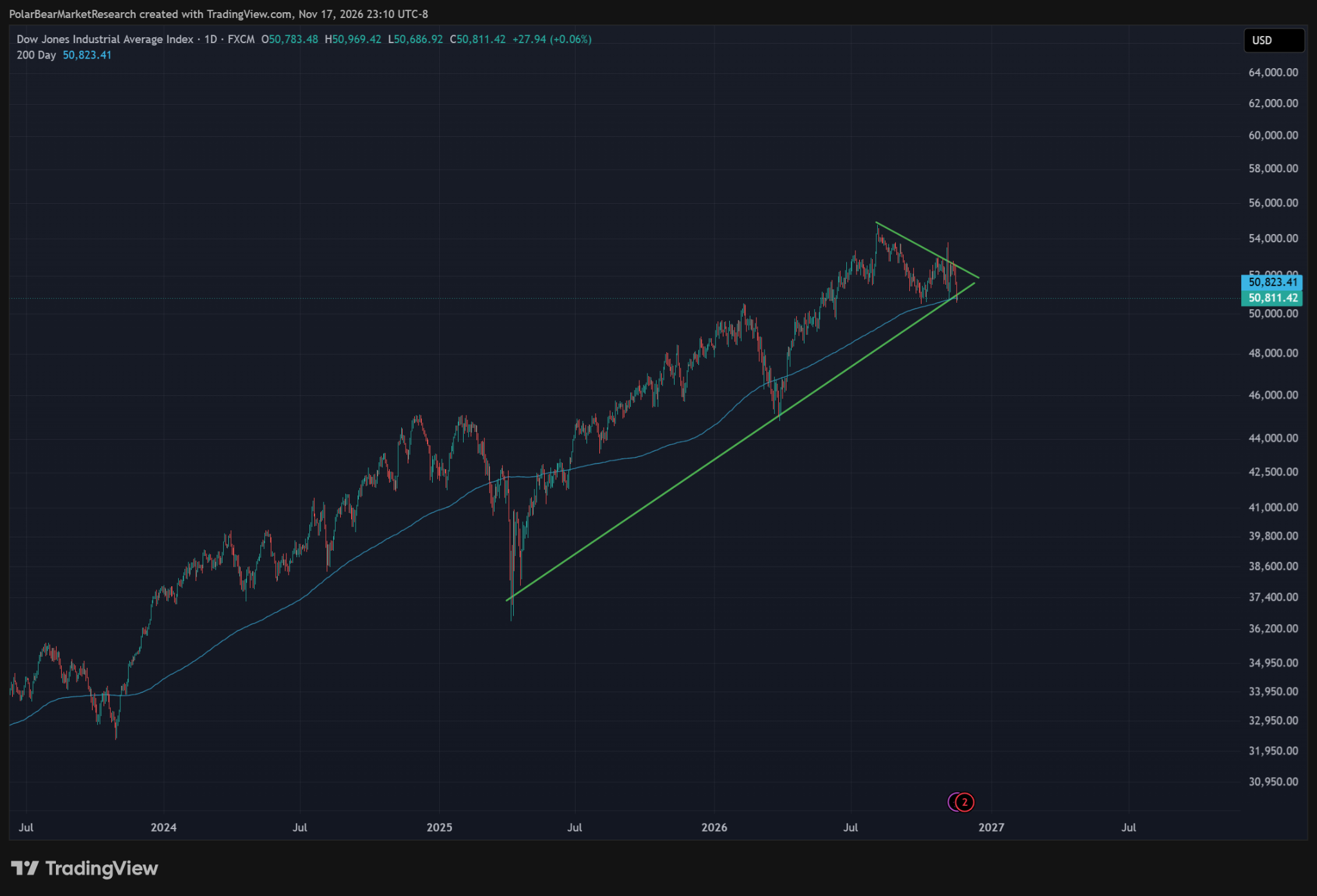
(Dow Jones, daily: the uptrend from 4/25 is being threatened, and others are following suit, as discussed below.) The false breakout a few weeks ago was brutally faded, and this is a critical spot. A breakdown here would mean a fundamental shift in market direction and in the landscape ahead, and it would validate our broader thesis that a ‘revenge of the old world’ economy and macro landscape is underway. From both a fundamental and a technical standpoint, there are once again plenty of warning signs, and the current regime doesn’t look sustainable indefinitely. Still, with short-term events like Trump’s visit to China and the Fed approaching its blackout window, the outlook stays relatively neutral over the next few weeks as we wait to see how all markets act at these key pivot points. Directional moves either way (discussed below in the technical outlook) will give us the framework for evaluating the next move, and patience is warranted in any Trump market regime. If the growth engine fires back up and the AI trade gets protected, they’ll move quickly to defuse much of the downside and bounce us back into these uptrends across the board, something they did extensively in the 2023-2026 period.
No lower low yet in tech means it’s not time to press the short side:
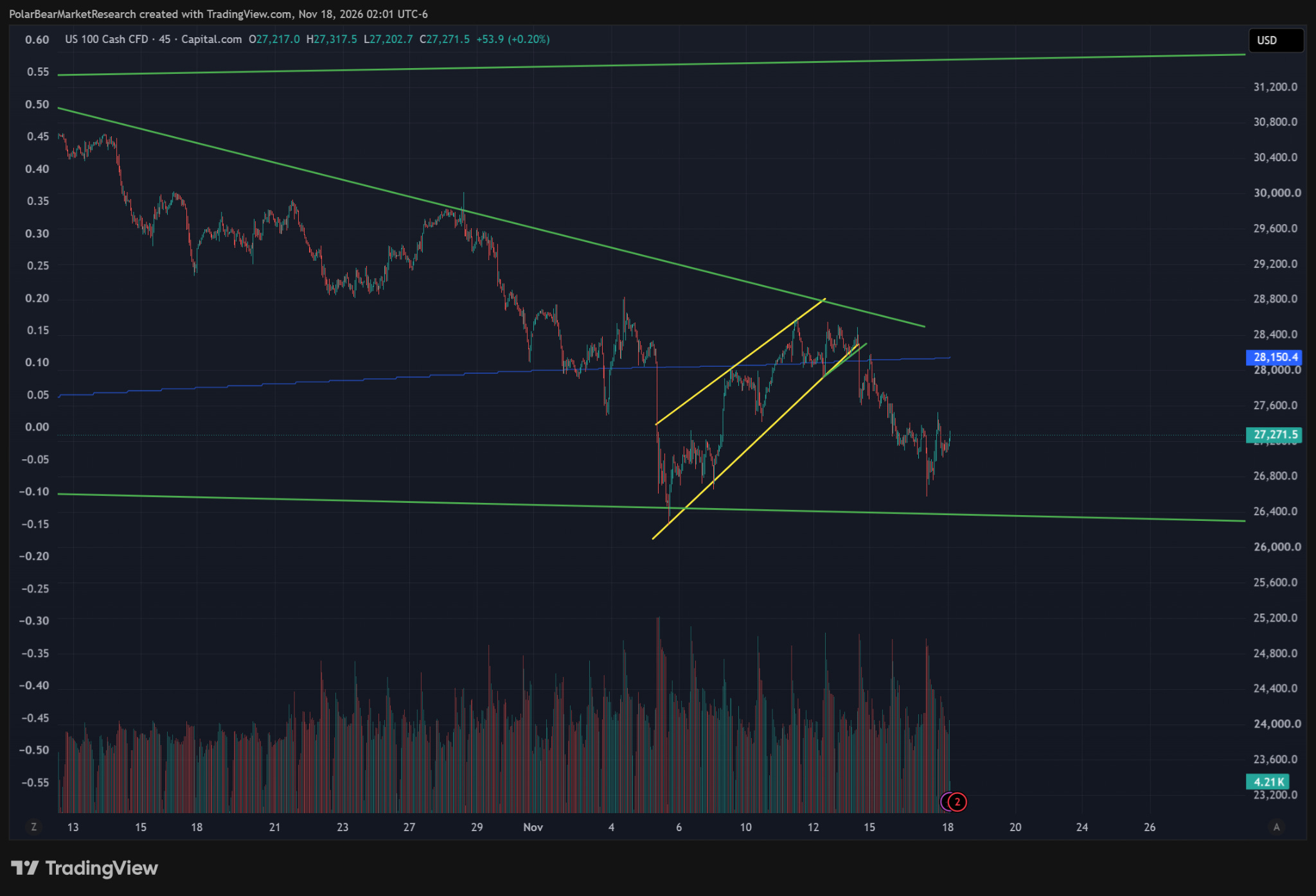
(Covered nicely by our friend PharmD KS…)
On the NVDA front, it was a very plain-vanilla earnings report for the firm. With Huang out, we’re seeing the firm transition into a more mature-looking enterprise whose growth rate will begin to slow rather dramatically (I suspect), as people with middle-management mindsets, rather than innovator mindsets, permeate leadership and execution roles. The call confirmed they aren’t looking for Huang to return, and we’ll discuss more in the recap below on what’s ahead for the firm. That matters for the entire broader market landscape, particularly the AI landscape, which effectively became the broader market landscape from January to present. With the Anthropic IPO on Thursday, that’s another catalyst for some short-term TACO as the Administration seeks to calm investor fears. I’m very curious to see how the market absorbs another IPO of this size before any OpenAI IPO, which could be akin to dropping yet another boulder on top of a sandcastle.
The war situation remains very fluid, and with oil now trading in line with growth, Iran has only gained more room to play a larger threat role in the region as it exerts more control over the Strait of Hormuz. Flows have dipped noticeably over the past two weeks, and I suspect they may settle at a lower rate through the end of the year.
This evening, we’ll dive into the latest on the war in ‘Trading Shots,’ share thoughts on the NVDA earnings saga and why I’m tuning it out, and look at the latest on the technical front. I’ll also cover some of Stanley Druckenmiller’s comments from earlier and which market regime they most align with historically. Sometimes in markets, sitting and waiting is the most intelligent move, and this is one of those points, because we’ll soon have further confirmation of what the market is telling us for the months ahead, once this tech-heavy correction has played out. Everyone is once again racing to call the bottom, call for the next 1987 next Monday, or call out the obvious. That uncertainty reinforces the casino times we’re living in. Still, I take the pragmatic approach in our heavily distorted post-2008 markets: the ‘powers that be’ would rather borrow from the future than pay in the present, and the equity market is a huge component of the economy, particularly under the Trump Administration, which has made nominal growth and consumption growth two major priorities.
For this evening, and to start your Wednesday, I leave you with this…

Not yet a MacroEdge Ozone subscriber? Get all of our research, market commentary, thoughts, and much more, below:
Report Schedule - Rest of the Week
Wednesday: Portfolio Strategy Note & Update - Six, Oil and Gas Strategy Note - Don
Thursday: Recapping a Busy Macro Day
Friday: Redeye Macro Note - November Technical Situation (A Global Look)
Saturday: Oil and Gas Weekly Macro Note
Sunday: Weekly Macro Note
Next week we will have the update on what’s ahead in 2027, and preview a lot of the exciting things we’ll be focusing on as we prepare for the turn into yet another new year.
War Update - Trading Shots
The war has pretty much been swept under the rug for now, as the latest dog-sees-squirrel distraction has been the Jensen Huang ‘scandal’ and his subsequent resignation, pulling investors’ attention away from energy markets and the conflict. By ‘the war,’ I’m referring specifically to the Iran-US/Israel war, where Iran has begun escalating again over the past few days in the Strait of Hormuz and through drone and missile attacks on several countries.
This drop in flows hasn’t mattered for oil markets, and I’ll go into more detail on why in tomorrow evening’s Oil and Gas Research note. To make a long story short, a combination of declining freight rates (which, for now, are no longer being passed through into the barrel price as the market has adjusted) and rising growth fears in the US and EU have contributed greatly to WTI’s recent decline from the late-October local high of about $106/bbl.
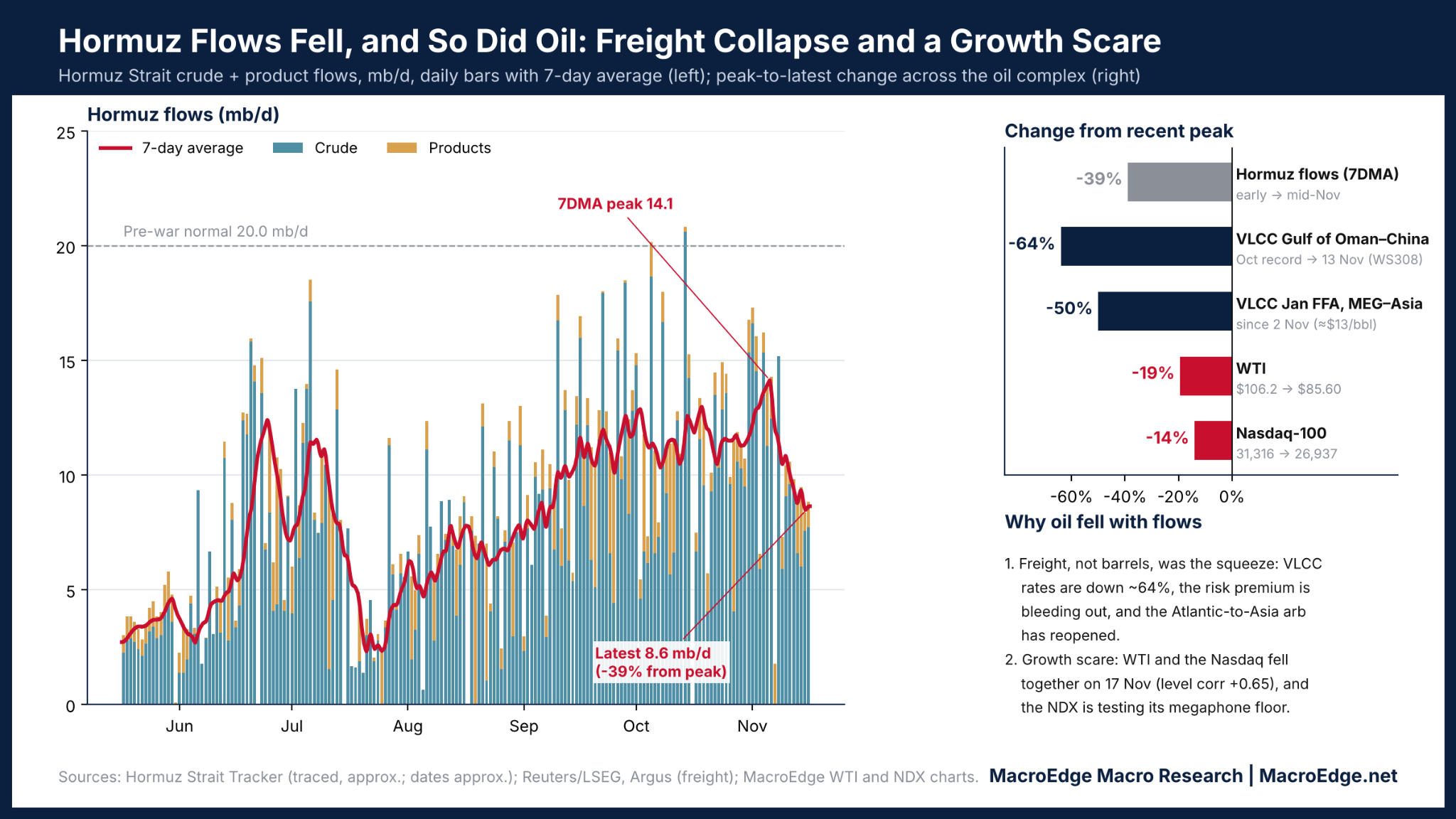
As growth fears continue, potentially into December, the market may once again overlook the fundamentals, and we could see a move similar to April and May, even though the inventory situation won’t change a whole lot. The market has proven very resilient, particularly in the US, which we expected from the beginning given our current production levels and our ties to South American oil producers. That doesn’t mean we’re out of the woods on higher prices in 2027, though, since a dynamic could set up that leads to cycle highs for WTI. We need to avoid the short-term thinking trap now permeating nearly everyone and everything in markets, and base actual decisions on the longer view.
Subscribe to Ozone below to continue reading —>
