

Don Johnson (@DonMiami3), Chief Economist
Good Monday evening MacroEdge Readers & Community,
This evening we’re going to deliver another brief War Note with the latest on the energy markets, technicals, and the Strait of Hormuz. After the wild overnight session yesterday evening, and shortly after publishing the Weekly Macro Note, we saw massive intervention from both the IEA and G7 through headlines stating that there would be joint strategic oil supply releases. The reality is probably somewhere along the lines of some releases coming if WTI > $85 in the coming days, and some of the headlines not being accurate overnight. Amidst the flurry of headlines, oil futures began to fall hard, bottoming near the $80 level at the lows and now standing back above $90bbl at the time of this writing. I do not think these small interventions solve the larger Hormuz problems for the time being, even though we’re seeing some pressure ease in the Strait. Production shut-ins continue to mount, and as long as we remain at a supply level of >10mbpd impacted, oil is underpriced at the level it is currently at. The likely outcome is Iran tees up for a scare blow to Western markets, which returns oil near the highs of the larger spook that made politicians intervene in markets.
For the time being, and as long as WTI remains steadily above $75bbl, oil and gas equities should continue to positively reprice - even though some of the more pure Bakken plays may get dented for a few days on the dip. The current supply issues are unlikely to be resolved for a month, even if the Strait was fully reopened tomorrow. With China and Russia stepping into the situation more aggressively, it sounds like we’re going to be left with a new Iranian regime under Khamenei’s son, who is actually more hardline than his dad. On top of that, given all these rapid market evolutions, the actual equity market structure itself looks like a dumpster fire. I’ve never seen such a mass brainwashing psychosis of Wall Street in terms of the *AI buy-in*, and I am even more uncertain of whether or not they actually buy into these processes or they’re paid on the backend to push the deals out to the public. Either way, they’re putting the broader macro backdrop at much greater risk - especially on the data center front - and even though that’s out of the headlines in the last few weeks due to the war, opposition is still mounting a fierce comeback from the ground level in small cities, counties, and communities.
It’s likely going to continue to be a blurry picture through the month of March, even if we see some resolution on the Iran-Israel front, oil flows, etc.
Let’s dive in.
Strait of Hormuz Traffic
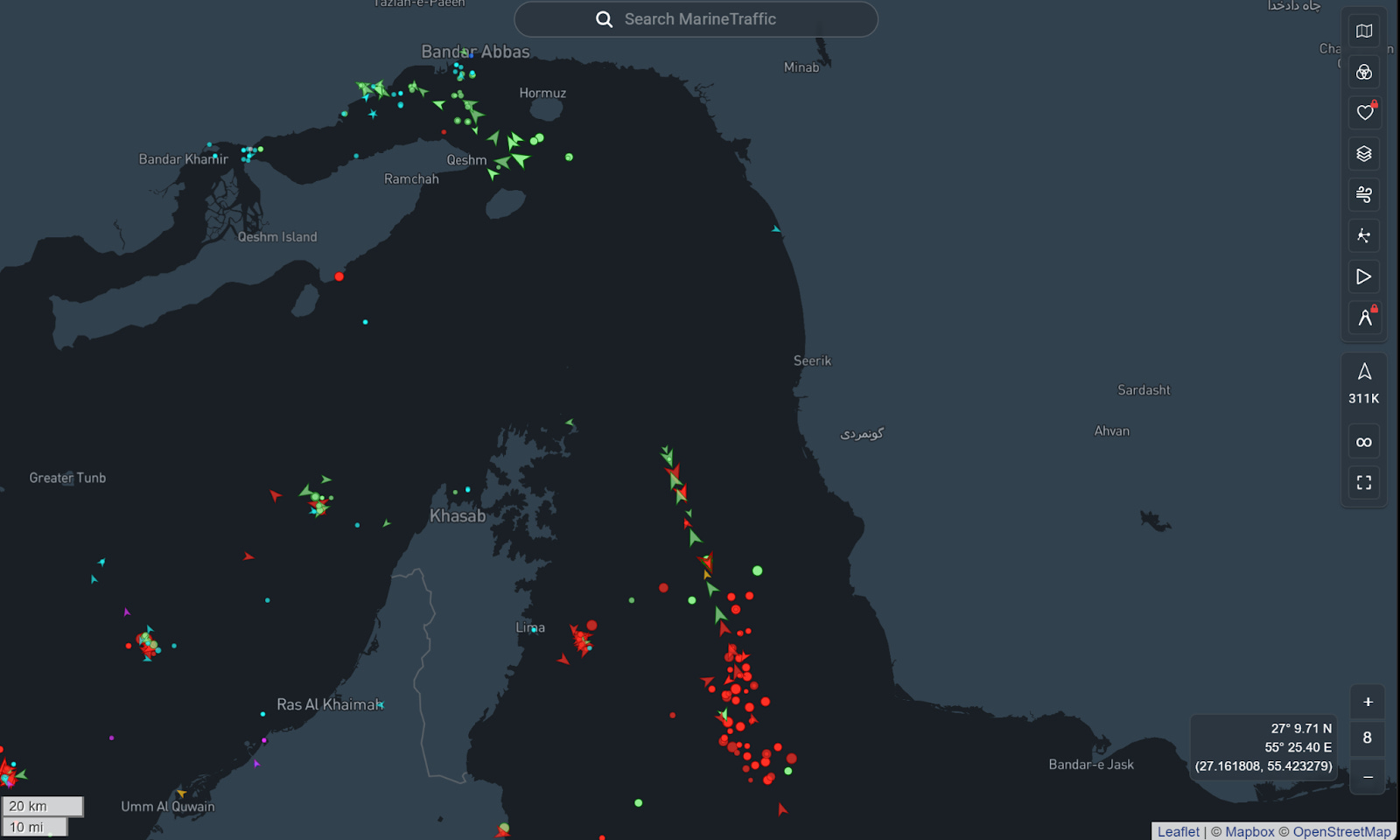
Movement in the Strait is reportedly ticking higher based on satellite imagery, but remains near zero. Roughly ~12 vessels made the passage today based on our best estimates, though some analysts have pegged that to between 12 and 14. Many of the carriers are operating by shutting off their transmitter, and turning it back on once they cross the Strait.
Trying to Flip the Energy Paradigm - ProFrac
If we remain in a WTI environment >$75bbl, we’re going to start seeing oil and gas equities broadly re-rate higher. This starts with the drillers, trickles into the E&P names, and eventually lands downstream in the
Operating Leverage in a High-WTI Regime: At current prices near $90/bbl, ACDC benefits from an exponential “pricing inflection” where revenue grows linearly with activity while EBITDA scales non-linearly. Because the company has cleared its fixed-cost “drag” at 170 national frac spreads, nearly every dollar of incremental revenue from the current completion surge translates directly to bottom-line alpha for equity holders.
Vertical Integration Margin Capture: Unlike peers that pay market rates for logistics and proppants, ACDC utilizes its own Alpine Silica mines to secure a $40+/ton cost advantage, which is particularly powerful during supply outages. This vertical integration acts as a “margin multiplier,” allowing the company to capture the full economic value of the 24/7 simul-frac operations.
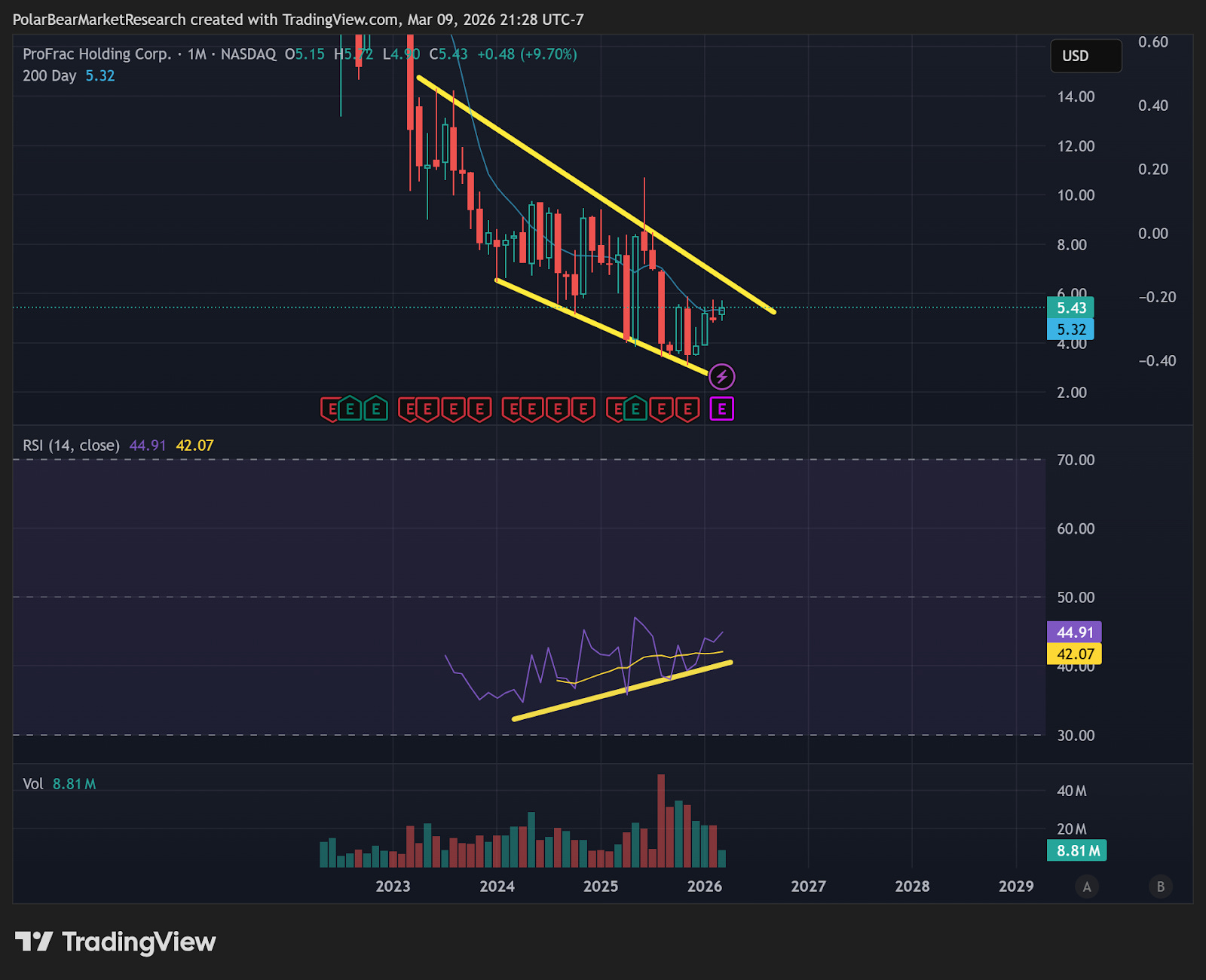
I am now including this in our broader oil & gas basket from the past few weeks, and because of the expansion potential in the space with a higher WTI environment, I think upside is there.
Technicals Overview - Stuck in Standby
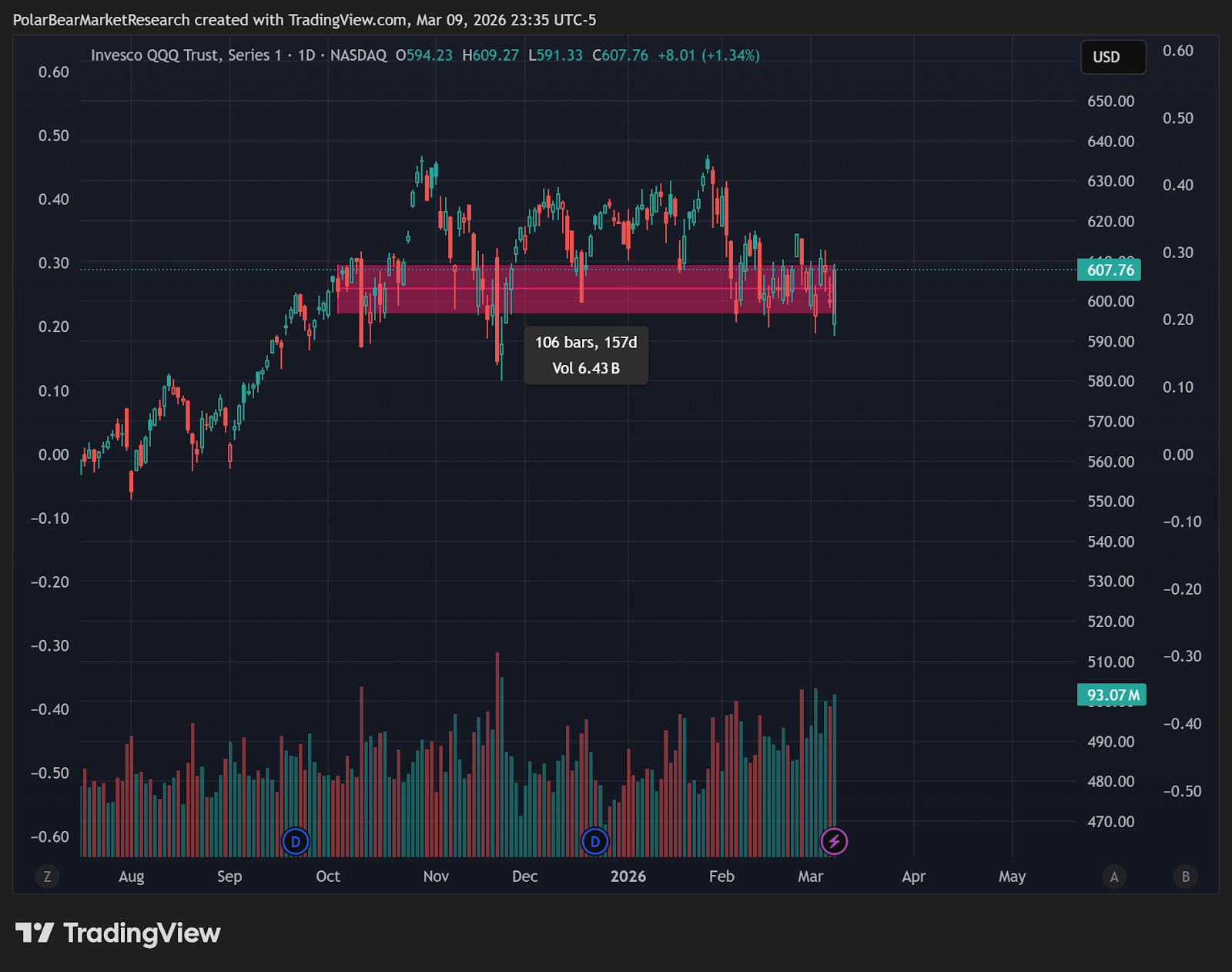
Technicals on the broader market continue to look very weak. In technology (QQQ), we continue to play this ‘rope-a-dope’ game. We’re approaching a full six months sideways in tech now, and the pattern continues to look broadly distributive. For all of the new narratives about AI saving the data and data center construction being where everyone in CRE is fleeing, under the hood, institutional money isn’t backing any sort of broader move higher. The same can be said for cryptocurrency…
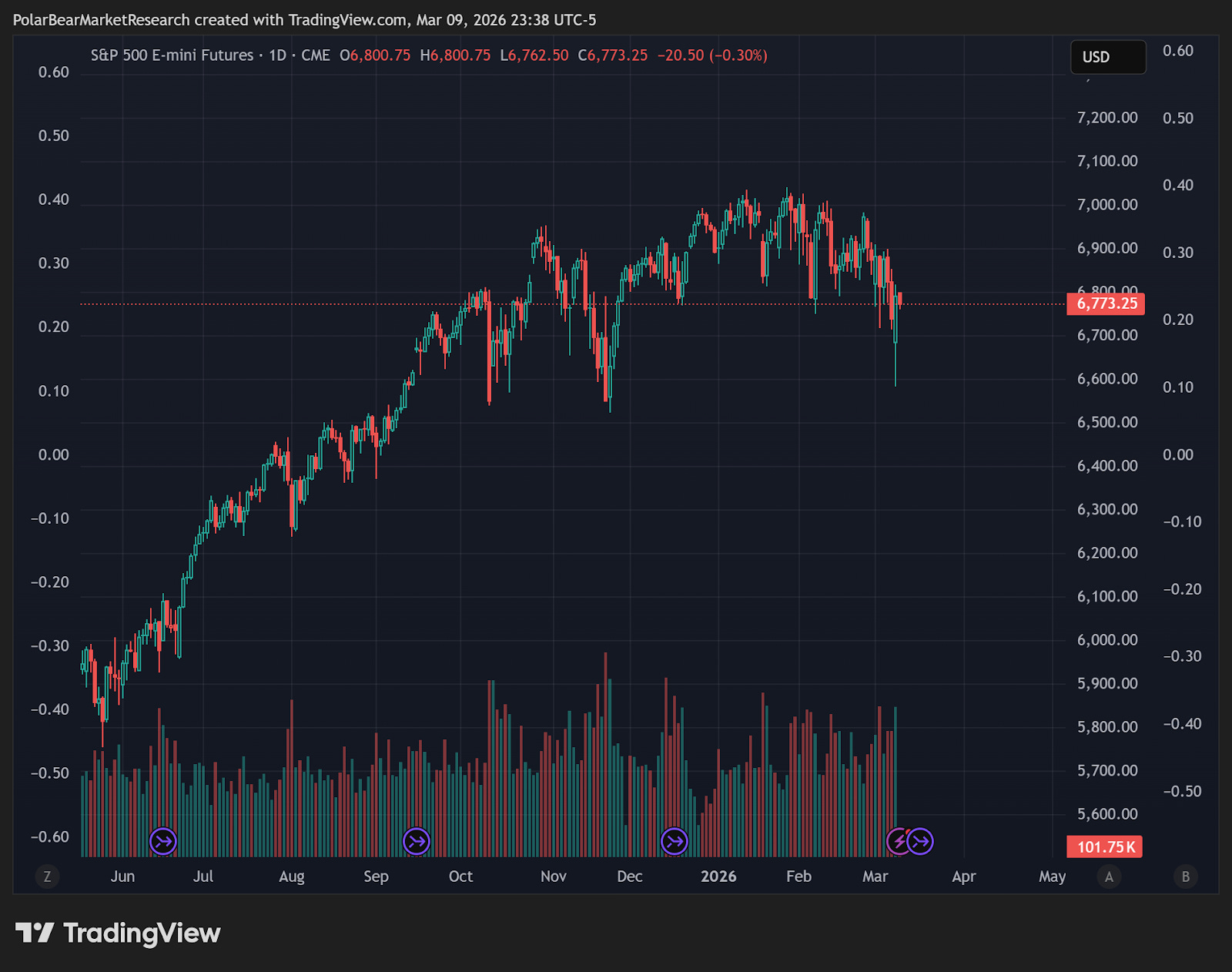
For ES - same situation:
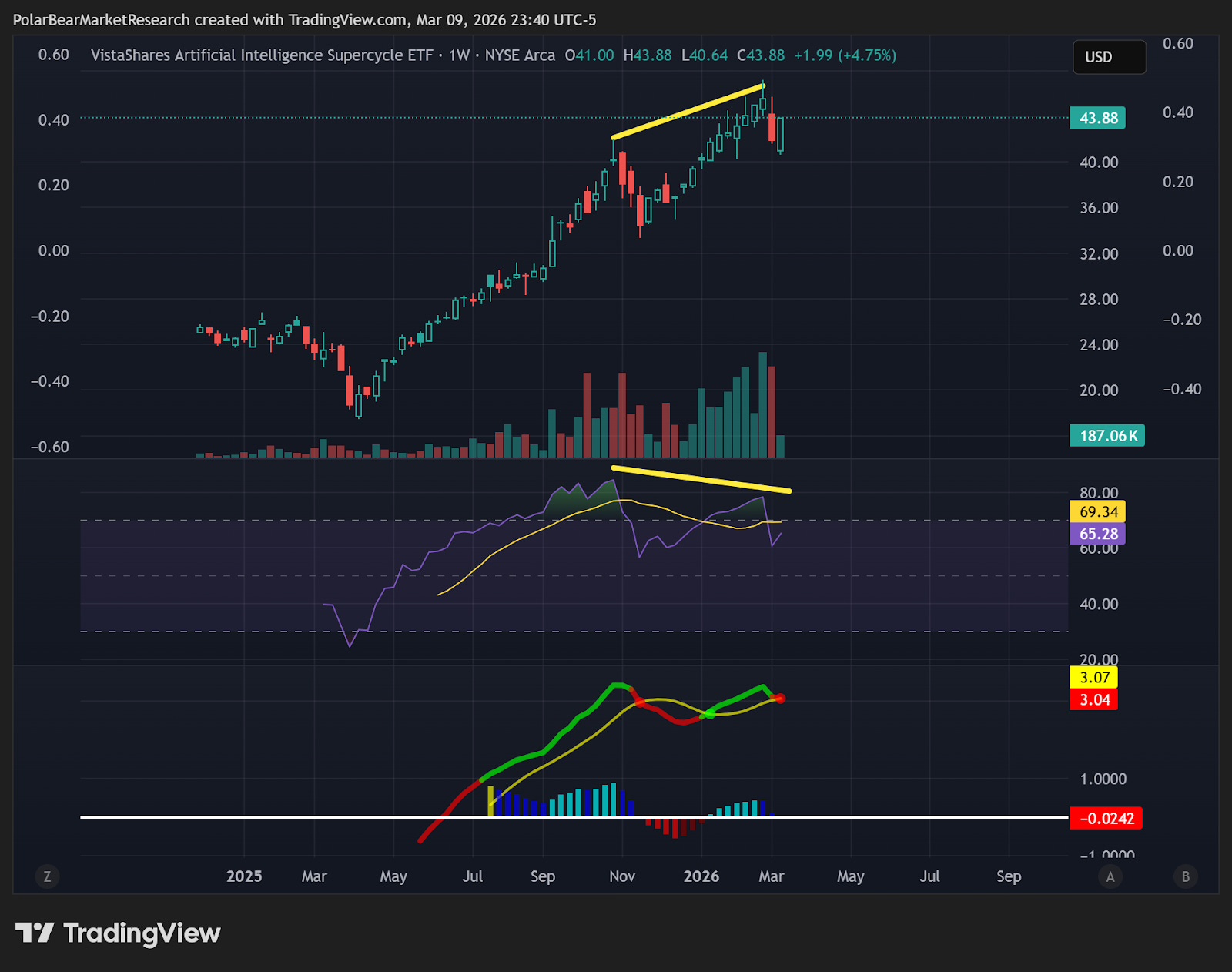
And for the AI trade - which has enabled much of this move higher on vaporware, the bounce back has already been significant - though negative patterns are forming (ie: on the weekly structure with the bearish divergence).
This shorter note format during the week is going to continue as energy market updates and war updates remain more frequent, so stay tuned throughout the week for more.

MacroEdge Portfolio Strategy Update - March 9, 2026 (@SixFinance, Head of Research)
What a truly insane day. I don’t have much to say tonight, but I took off most of my positions this morning. I have monetized my ES bear spreads fully, sold all of my equities, and, as of now, I am holding only my software bull spread basket. I am now holding a majority cash position.
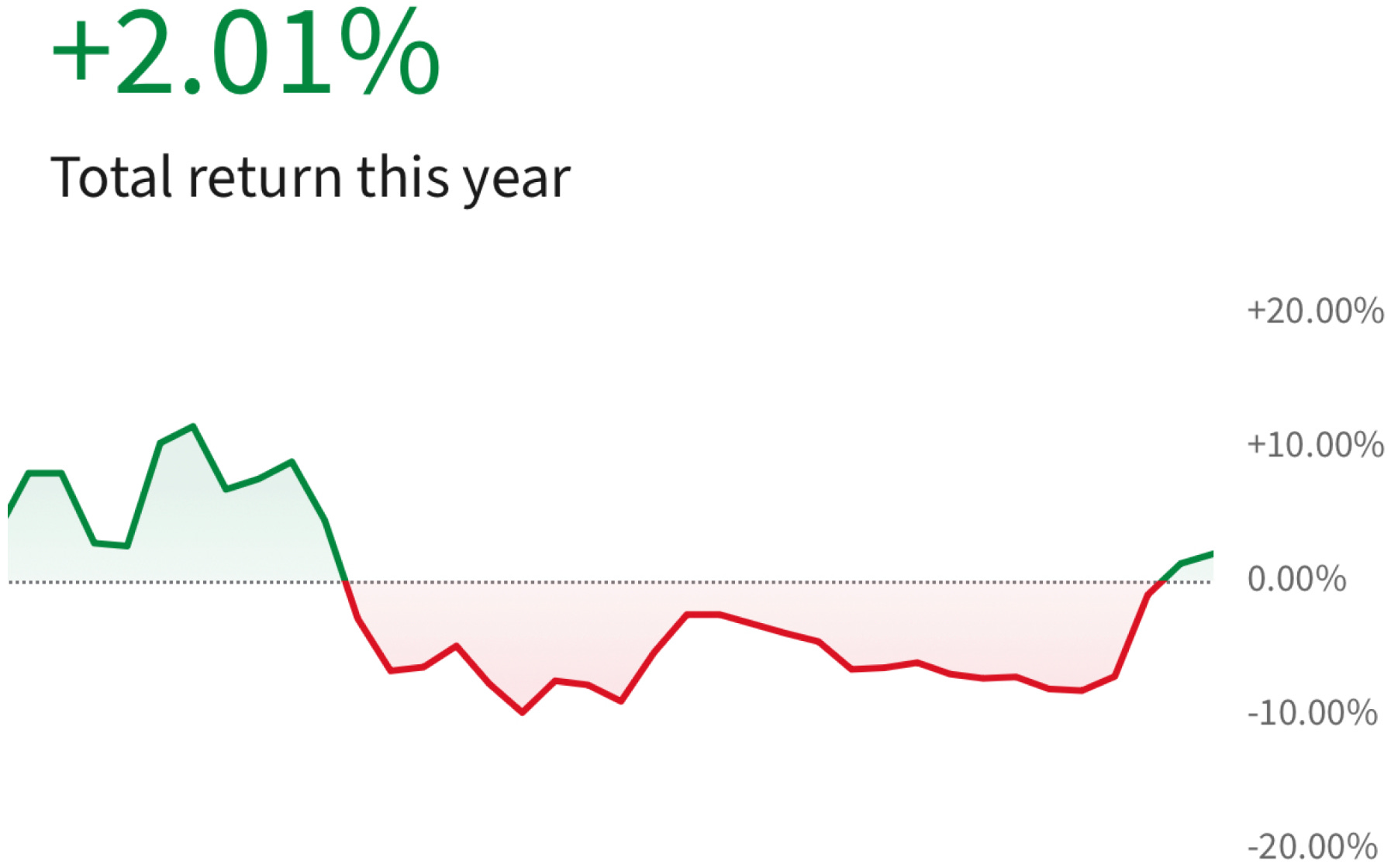
I have little conviction at the moment, so I plan to hold a large cash position and let the dust settle from this conflict, and let the market come to me. The last couple of weeks have been very rewarding and I see far too much risk with the Straight still closed to rush in and buy the (barely noticeable on a daily or weekly chart) dip.
Bottom line: the Strait of Hormuz is still closed, and despite all of the rhetoric today, “Operation Epic Fury” is still ongoing. Risk is still very elevated.

For more details, please refer to our Terms and Conditions.