

Good Saturday evening, MacroEdge Readers & Community,
As I finally sit down after nearly 30 hours on the road, I find myself appreciating the little details, like being able to drive thousands of miles in a short period of time. So many of these things were born in the 1800s and 1900s, and it’s a marvel what previous generations were able to build with far less information at their disposal. Today’s information-abundance curse will have profound effects on humans this century, especially as we accelerate toward the ‘demographic endgame,’ which only seems to speed up as we borrow more and more aggressively against future generations that are likely to keep getting smaller for the foreseeable future. Those of us able to take advantage of the knowledge databases at our fingertips, especially many of you readers, are at a great advantage over the general population.
We can also take a more pragmatic approach to viewing markets, both here at home and abroad. In the post-2008 era, the United States chose to financialize its economy at the cost of everything else and make stocks the #1 priority, even to a national security degree, as we’ve seen throughout the last decade with the pandemic, earlier this year at the start of the war, and the list goes on. Given the ever-fiercer defense of the Ponzi-scheme system we enacted after ‘08, it’s gotten increasingly difficult, as a macro pragmatist, to ever get overly bearish on aggregate indices. Price action since 2023 has reinforced that even further, after the SVB bailout era and the immediate extension of monetary support to Silicon Valley. With Silicon Valley now directly at the levers of many of our economic policies, we have to ponder a daily question: where do we go from here? Outside the data center and AI trade, the market is a very different place, and has been for much of the year, and the same is true of major sectors of the economy. Data center construction clearly launched almost concurrently with all-time-low real estate activity and a very severe real estate recession, hence my labeling of many of these facilities as our own version of the Chinese ghost cities. Everyone will dance around like sheep and seals, clapping for the construction of these facilities with little to no understanding of their broader benefit at the community level, and without even pondering what the hell we’re committing trillions of dollars to in this ‘AI’ buildout. As a broader society, there are so many questions we should be asking and aren’t, and that’s why I struggle with the current macro backdrop to such a great degree. It pains me to watch it head the direction it’s going, but our policymakers will never commit to lasting solutions to prevent it, so we’re left relying on things like the bond market to find any sliver of sanity left in this era of fiscal recklessness.
Another question we need to look in the mirror on as a society is what the concept of a nation even means anymore. Over the last several months, hearing conversation after conversation in bars, lounges, flights, meetings, and more, it seems to me we’re little different from a bizarre casino-Ponzi scheme at this point: an asset-owning class that has benefited enormously over the last 18 years, and the bottom 90% of the ‘i’ (the narrow stem of asset owners at the top, and everyone else beneath it) that has essentially died in real terms over that same period. Let’s not even get started on the situation facing young people in the West, which is very bleak. But as I suspect, if we don’t course-correct our policy failures, either markets or nature will correct the course of compounding failures over time, even if that process takes many decades. We have a large and growing geriatric population that rages every time markets pause their relentless charge higher, even if largely in nominal terms, and a system that relies on that charge continuing. We’re creating the conditions for much broader issues, both over the next couple of years and over the long run, if we don’t stop and address our inflation and fiscal problems now, and together rather than in isolation. We could of course delve into the Fed’s balance sheet issues and the fact that it monetized housing to an unprecedented extent during the pandemic, but that’s well in the rearview mirror. Let’s just look at the issues we have today and mark that as the starting point.
That leads me to the changing winds of ‘Powell’s Valhalla,’ a phrase I began using in early 2023 during the SVB bailout. Are we as a society willing to take inflation and the ‘i-shaped’ macro issues seriously, or are we going to look at the brief blip of the last 7 months and say we can’t do this anymore…? Much of that depends on which side of the trade you’re on, of course, and on your asset mix (Chris Whalen’s tweet earlier on home prices is one example of personal-impact bias framing)… There are signs the winds are beginning to change on the 2023–2026 era of fiscal and monetary policy failure, but it’s far too early to call it a directional trend. That’s why we’re going to discuss the signs of changing winds while also questioning our own framework as it pertains to the next ‘up and to the right’ move in equities, the one the Trump Administration so desperately wants and needs to keep fueling the US stock-market-driven engine. The United States of Stocks is now a system built on the perpetual bailout-and-intervention model, at the cost of everything else. That’s why it keeps getting harder to develop any narrative that challenges not only prevailing sentiment, but also the prevailing need of those who rely on the up-and-to-the-right fiscal and inflation-dominance regime to keep thriving at everyone else’s expense.
Tonight won’t be a look at the war, and we’ll set aside most of the discussion around macro data releases. Instead, we’ll take a more in-depth, research-first look at the signs and signals that the Powell-induced Valhalla regime is changing for certain assets, along with a general framework for which assets may outperform in a ‘revenge of the old world economy’ trade, if we can actually transition into one in 2027. Can we take the medicine and correct the ills of the ‘08–‘26 landscape, or are we going to embark on more of the same? Let’s explore some of these difficult questions below… Remember, we’re not here simply to look at the problems. By identifying what’s ahead, we can also identify the tremendous thematic opportunities at the macro level, and exploit them.
As I finalize our new hub and operational setup in Arizona through Tuesday, I appreciate the patience you’ve all given us. This change and rebasing was a key component of our 2030 vision, and it will enable much bigger things in the years ahead for our firm and our broader group of firms. Once the process is complete, I’ll be heading back to Wichita Falls, TX for an oil and gas-focused week.
Next week, we’ll have our full 2027 preview and outlook available, covering everything in store for next year, including our new report and research schedule, bolstered by a 6-member contributor team, plus Don’s Whiteboard, thoughts on our oil and gas business, and more. It’s going to be a brilliant end to the year, and this is arguably the best time of year to go full throttle while everyone else lets off the gas. That’s exactly what we’ll be doing, and I hope you enjoy what we have in store.
Tomorrow evening we’ll take a look at the futures and the week ahead, which has some huge macro-level events (like the ANT IPO and NVDA earnings), potential TACO announcements, and much more. We’ll also discuss the report schedule for the week ahead.
Not yet a MacroEdge Ozone subscriber? Upgrade below to get all of our research, data, portfolio strategy, commentary, and much more →
Early Signs and Signals that Powell’s Valhalla Regime is Struggling
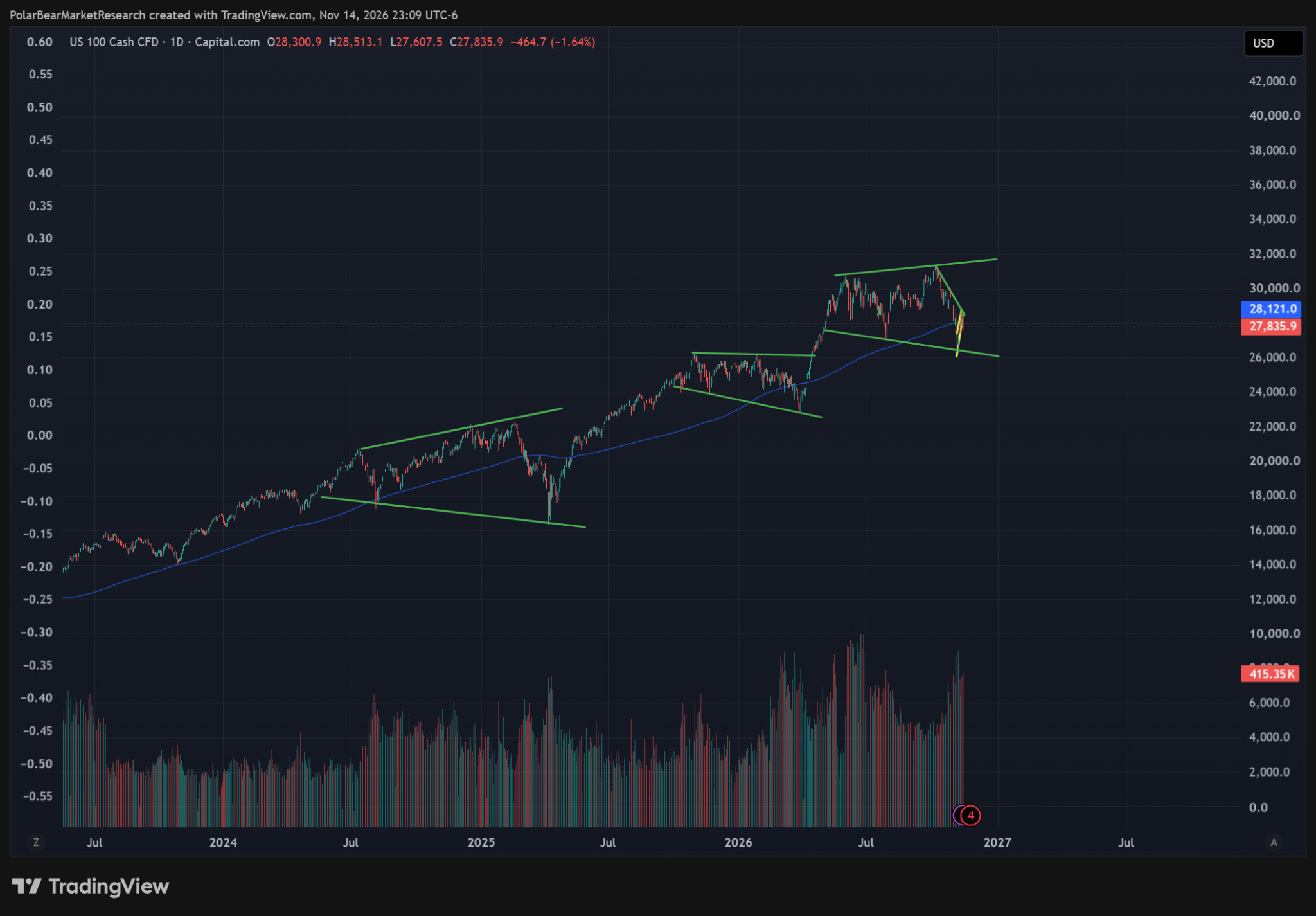
In terms of the transition from the post-Powell era, we have to understand that this is coming from a very limited window where the Warsh Fed hasn’t yet proven itself meaningfully different from Powell. While there have been some minor changes, there need to be broader signs that we may be shifting into a ‘65–‘82 style environment before declaring any fundamental shift in how the Fed conducts monetary policy. That’s also only one small element of the broader picture. Given how reliant we’ve become on nominal prices and assets going up, the fiscal component of our macro picture is basically in runaway mode, with few signs of stopping. While Bessent & Co came in back in early 2025 promising to fundamentally change things, they have done very little other than bolster the data center construction cycle and support stocks going higher, both in the United States and across the hemisphere (particularly in South America). We may also simply be forming yet another broadening pattern, which we’ve seen time and time again in this regime. But with the core drivers of the cycle breaking down, there are reasons to think this time might be different, particularly as we stare at another Fed rate increase in December, and potentially up to three between now and March 2027.
Just another Powell’s Valhalla ‘Broadening Pattern,’ or a regime change underway?
From January 2023 through the October 2026 peak, the Nasdaq 100 nearly tripled, and every dip was bought within weeks. That was Powell’s Valhalla. The deck argues it may be cracking under Warsh. A supply-shock inflation, a stop-start hiking cycle and record leverage now line up with 1973 more closely than with any other post-war setup. The positioning answer is the ‘73 Five, not long-duration growth.
Note that not every slide mentioned below is contained in this Ozone note. The full deck of 17 slides can be requested via email, or by messaging us on Substack.
I. The regime at its peak (pp. 2–4)
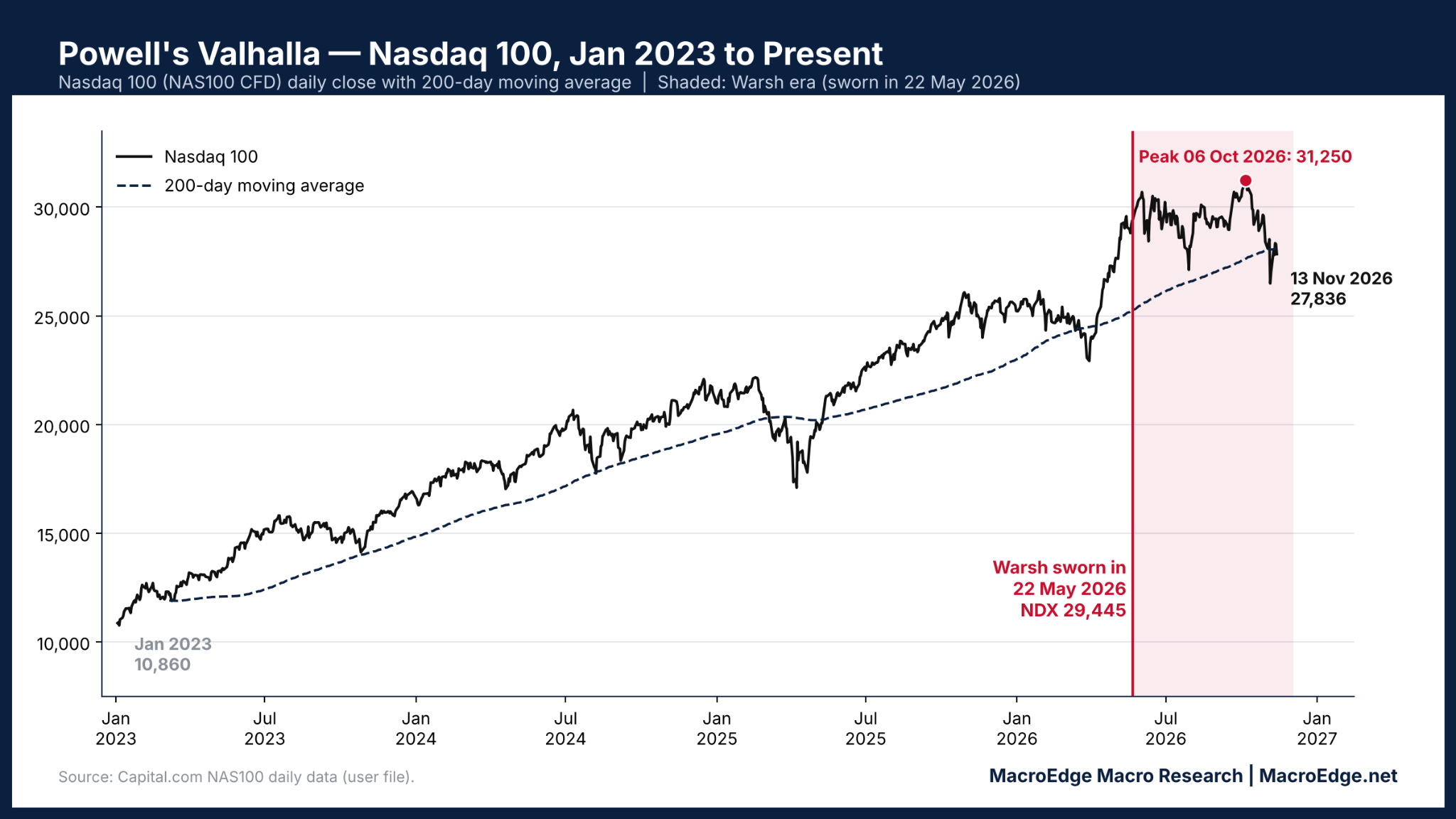
Valhalla in one line. The Nasdaq 100 went from 10,860 in January 2023 to a 31,250 peak on 6 October 2026. It closed at 27,836 on 13 November, about 11% below that peak, and is testing its 200-day average for the first time in the Warsh era (sworn in 22 May 2026).
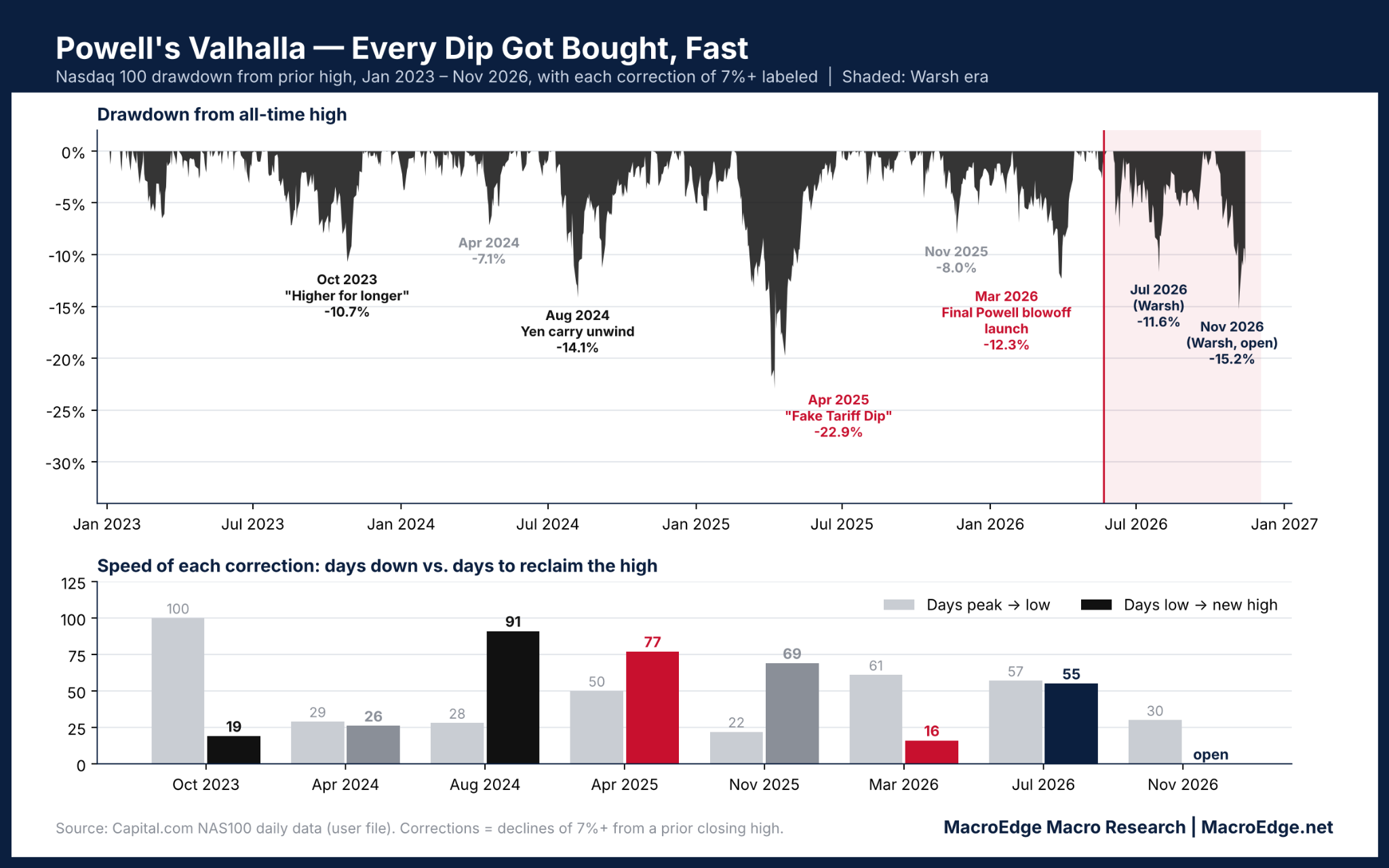
Every dip got bought, fast.
Eight corrections of 7%+ since 2023, including the “Fake Tariff Dip” of –22.9% in April 2025, and every one of them reclaimed the high.
The current drawdown reached –15.2% at its low, the deepest of the Warsh era, and it is still open.
Recovery speed is the tell: when the bid stops showing up within weeks, the regime has changed.
