


Good Thursday evening, MacroEdge Readers & Community,
It’s time to just chill out and go back into patience mode on the left-tail side. Today was a historic bloodbath across AI, data centers, and everything in between, and it was the panic moment we’ve been waiting for.
Today’s Midweek Macro Note will be mostly politically focused, given all of our coverage over the past 48 hours. We’ll look at some of the likely impacts of this so-called ‘Blue Tsunami’ and then highlight the many things that are unlikely to change. As with most midterm cycles under a deeply unpopular executive agenda, the largest policy impacts will actually happen way down the chain: at the city and county level, and then up to the state level. I never overweight these events in the context of markets or everything that was happening before the election, but there will undoubtedly be some important changes we should be aware of. The bulk of those changes will now happen at the state level and below (in places like Arizona, where Democrats hold the state-level trifecta for the first time in 60 years). Much of what we’re seeing continues to follow the ‘Project ZA’ narrative we’ve discussed since 2023. While the days after a result like this bring a lot of mixed emotion, this outcome should not have been outside the realm of anyone’s expectations.
Last year, we became one of the first organizations to start warning about data center opposition. Having lived in Abilene, TX myself during the Stargate permitting process, much of which was done in secrecy, I saw the writing on the wall early in the visceral anger many residents were beginning to feel about the projects. Company representatives and lobbyists from firms like Google came in and lectured middle America on why it was their duty to give up a lot for very little in the way of long-term job prospects for the community. That rubbed people the wrong way. Voters looked at local power costs, the water demands of these facilities, and being replaced in the workforce to boost net profit margins for corporations already enjoying record-high margins, and they saw net negatives. What Tuesday night showed, once again, is that there’s a lot of anger and a lot of misunderstanding about how we solve the endless challenges and problems we face in the modern US economy.
In terms of results, Texas was the ‘big surprise’ for most (not for us). Democrats captured all 17 state-level races and flipped the state House, and the GOP’s last legislative block came at the State Senate level… This devastation for the GOP came in areas and regions that were just redistricted, and it was an enormous swing from anything seen even in the post-2020 era. While I suspect a lot of people will over-extrapolate Tuesday night, the ‘right’ in the US continues to shift left, and Texas will likely experience a political decade similar to Colorado’s in the 2010s, when the state began receiving a huge influx of California residents and businesses. The state remains an oil powerhouse in certain counties, but things will be changing on that front in Texas too, quite possibly as soon as 2028 if a second Railroad Commission (RRC) seat flips, something I do suspect might happen. If that occurs, we’ll start to see a leftward shift in state oil and gas policy, and the Wild West Texas oil days will come to an end. Ironically or not, that fits the bill of what we’re seeing as the shale days mature: inventory is getting more constrained, and onshore oil and gas needs to figure out how to make EOR and secondary recovery more worthwhile in conventional assets. Unfortunately for a lot of companies, even when they seem to ‘get it right,’ they’re often hedged against the upside. After weeks like this one in oil markets, a lot of folks are simply exhausted about making any investment in the future when every government on earth is constantly at war over prices.
For the GOP, it’s not an end-of-the-world signal, but it’s yet another marker of a leftward shift the party will need to make to appeal to independents in the future. The results are not going to stop the ‘South Africa’ trajectory the US finds itself on. For now, though, it’ll feel really good for about a week for those opposed to the war and to data centers, those who want real opportunities as small businesses, those tired of seeing groceries go up 20% YoY, and the list goes on. We live in a world where I frequently find myself checking the real prices of things: what prices were last year, where equity indices were last year, where they were 6 years ago, and so on. I don’t think this midterm result changes any of that. As for the shift toward the ‘old world economy,’ I suspect that is also well underway as we move toward living in a world with more scarcity. We live in an illusion of abundance, particularly in the social media world, and reality is rarely what meets the eye anymore. For us at MacroEdge, continuing to search for the truth, regardless of the hot narrative of the day, is our mission and purpose, and I’m thrilled with how accurate our data center outlooks, commentary, and data tracking have been up to this point.
On the war front, whether this marks the end of the cycle or just another ‘TACO’ point, I don’t think the US is simply going to give up control of the Strait of Hormuz. If it does, that will be another signal of weakness to the world in terms of power projection. I strongly suspect very little will get done at the federal level over the next two years, though letting yields and the bond market reset may be the Trump Administration’s goal before it resumes strikes on Iran. Once again, this election was a massive rejection of a lot, not a mandate for much. Opposition is usually a lot, lot, lot more united than the other way around, and Tuesday night was a case in point.
Outside of that, today’s market action was the so-called necksnap I had been waiting and positioning for over the better part of two weeks. This was one of the largest single-day volatility moves on record, and at the time of this writing, Korea is halted, down 9%... Both sides are blaming each other, but today was largely the free market at work. It wasn’t regulation, and it wasn’t Trump. The market simply, finally, acknowledged the plethora of issues facing the AI and data center economy.
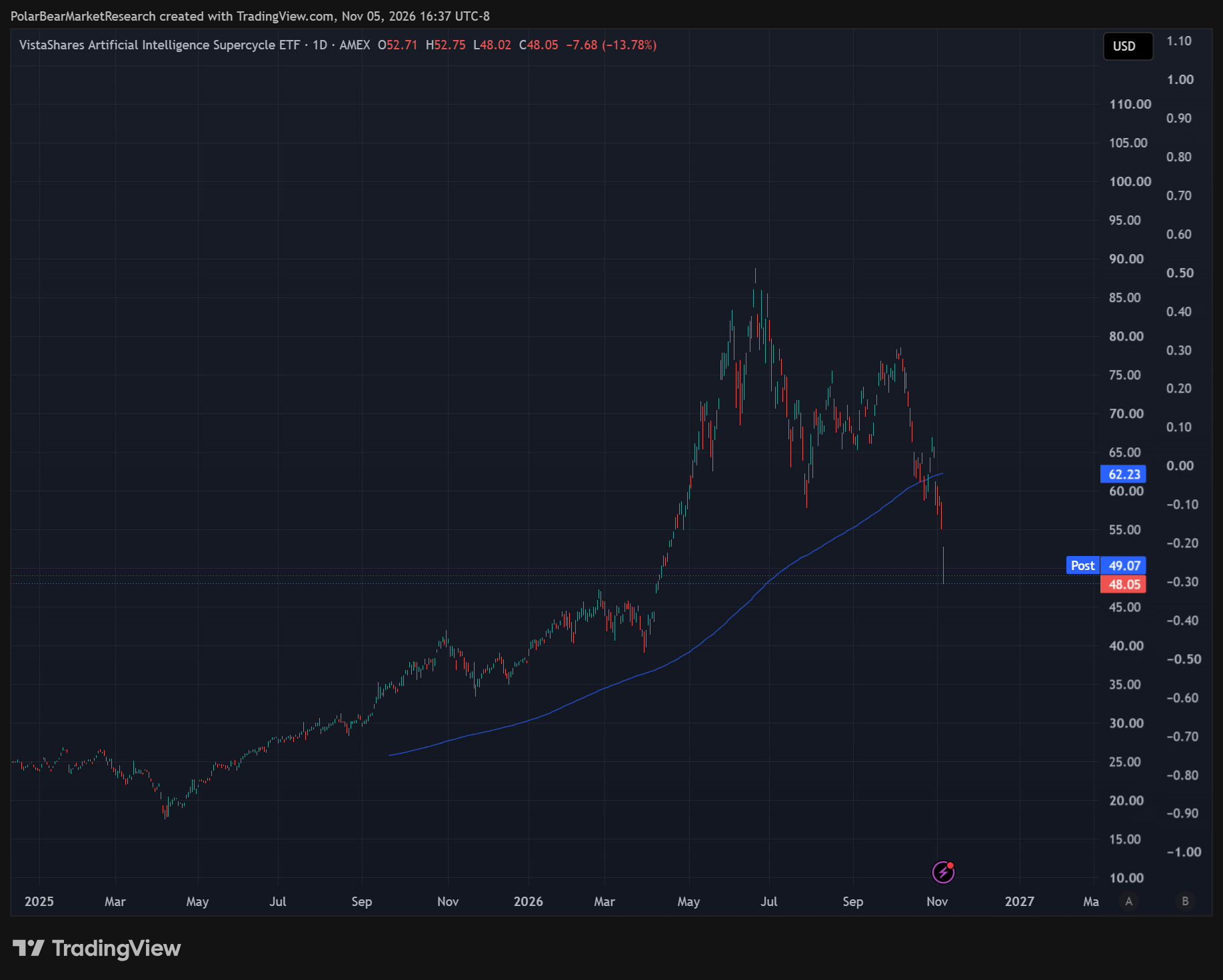
(AIS) AI ETF
These structures all have similar echoes:
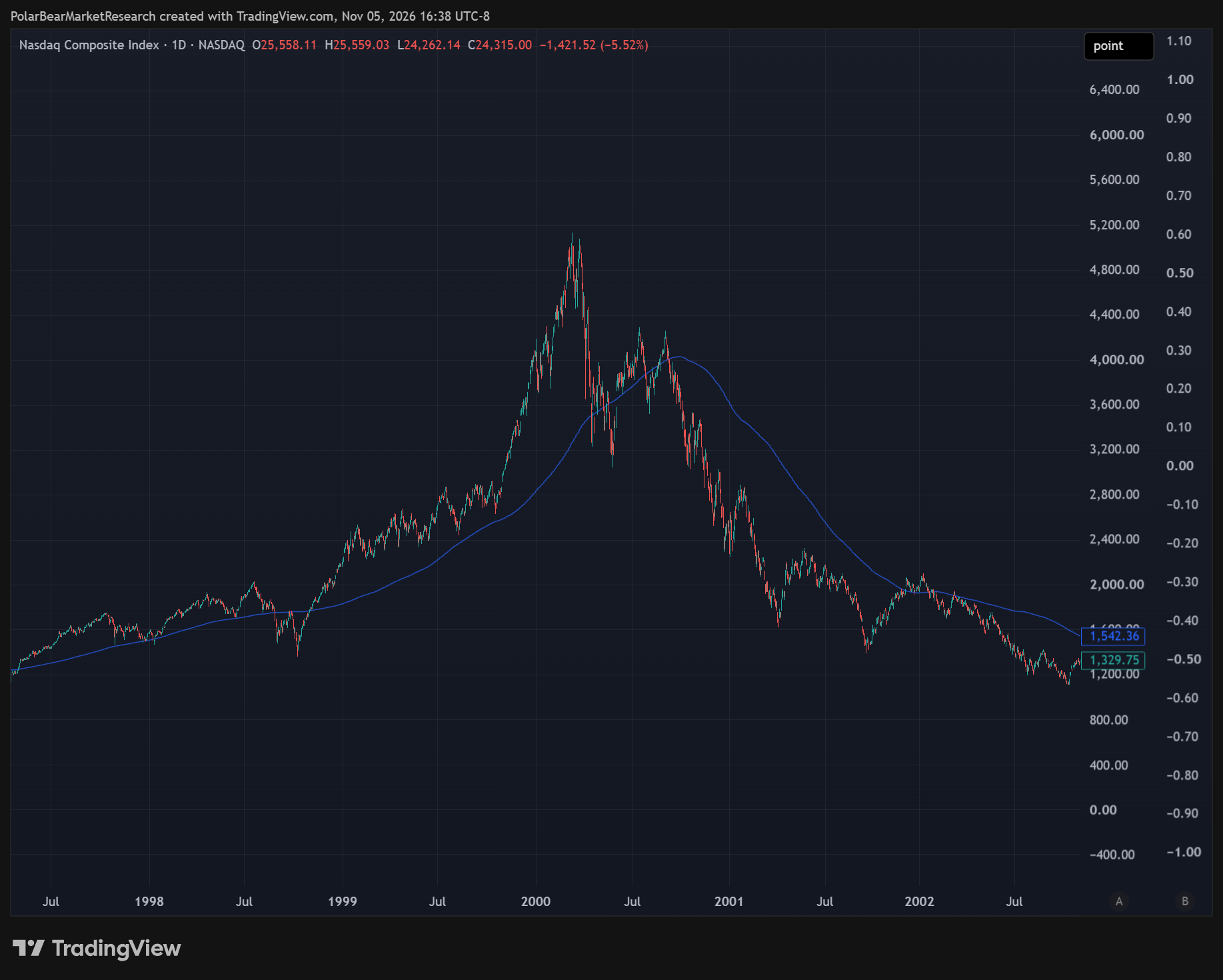
Months ago, I noted that the cycle had ended. It has, but it’s going to take a significant amount of time to play out. When specific names pull this far away from the 200, that line has to play catch-up to price action… That’s why these moves are so difficult to navigate. Given a lot of today’s breakdowns, I don’t think chasing bounces is particularly conducive to success, but nothing has changed in terms of the syndicate in DC likely coordinating to make its move. Today was likely the early stage of several weeks of price action I want to see materialize before preparing for further volatility, which may come after the next FOMC meeting in December, when the Fed needs to hike. It’s time to just chill out on the market front now, especially on the AI and data center trade, as we wait to see whether they throw any interventions or emergency measures out there to kick the can sideways.
This evening’s Election Recap and Alarm Bells note is the last in a sequence of three reports, following yesterday’s Oil and Gas Strategy Note and Portfolio Strategy Note.
Not yet a MacroEdge Ozone subscriber? Pricing has increased to $45/mo and $399/yr, and you can secure your subscription rate through year-end by upgrading today for all of our research, portfolio strategy, data, and much more below.
This evening, we’re going to cover the following topics:
Breaking down the results: national to local
Market structures: tech necksnaps
The data center and AI impact: what it means and why it’s time to ‘just chill’
Transports and airlines: signal or noise?
Impact on energy prices
Employment report outlook
Breaking Down the Results - National to Local
The results across the board were devastating for the GOP at every level. Democrats will have their largest House margin since the 1990 election, and in the Senate they’re set to hold 56 seats (55 officially for now, since Mississippi will likely go to a recount). Florida remains the last true large state under GOP control, and even there, Donalds pulled it off by a 1% spread. The agenda of the DeSantis era will likely stall now, and as long as the GOP keeps floundering on delivering policy results at the federal level, and even the state level, it will be punished severely… Many of the 2024 voters who gave it a shot felt betrayed, and that explains a big, big part of Tuesday’s results.
A lot of pundits think this was ‘just another midterm,’ but I think it foams the runway for a ‘Democrat era’ through at least the remainder of the decade. There’s also little reason for Democrats to impeach Trump right now. If he keeps providing this large of a boost for Democrats up and down the ballot, why would they get rid of him? They won’t. Will this play into a wind-down of ‘Powell’s Valhalla’? I think it will.
Market Structures - Tech neck snaps
In terms of market structures, today was the necksnap moment I had been waiting on for the better part of several months, following negative divergences, a massive lack of volume, and a laundry list of other risk factors. There are international ramifications too, in places like Spain, which we need to keep monitoring. A lot of people made the huge mistake yesterday of pulling their hedges against exactly what happened today, and I know there are some strong regrets about that. Now it’s time to wait and let the market get its shirt re-buttoned before getting overhyped about another directional move. Today’s devastation speaks for itself, in shape and form.
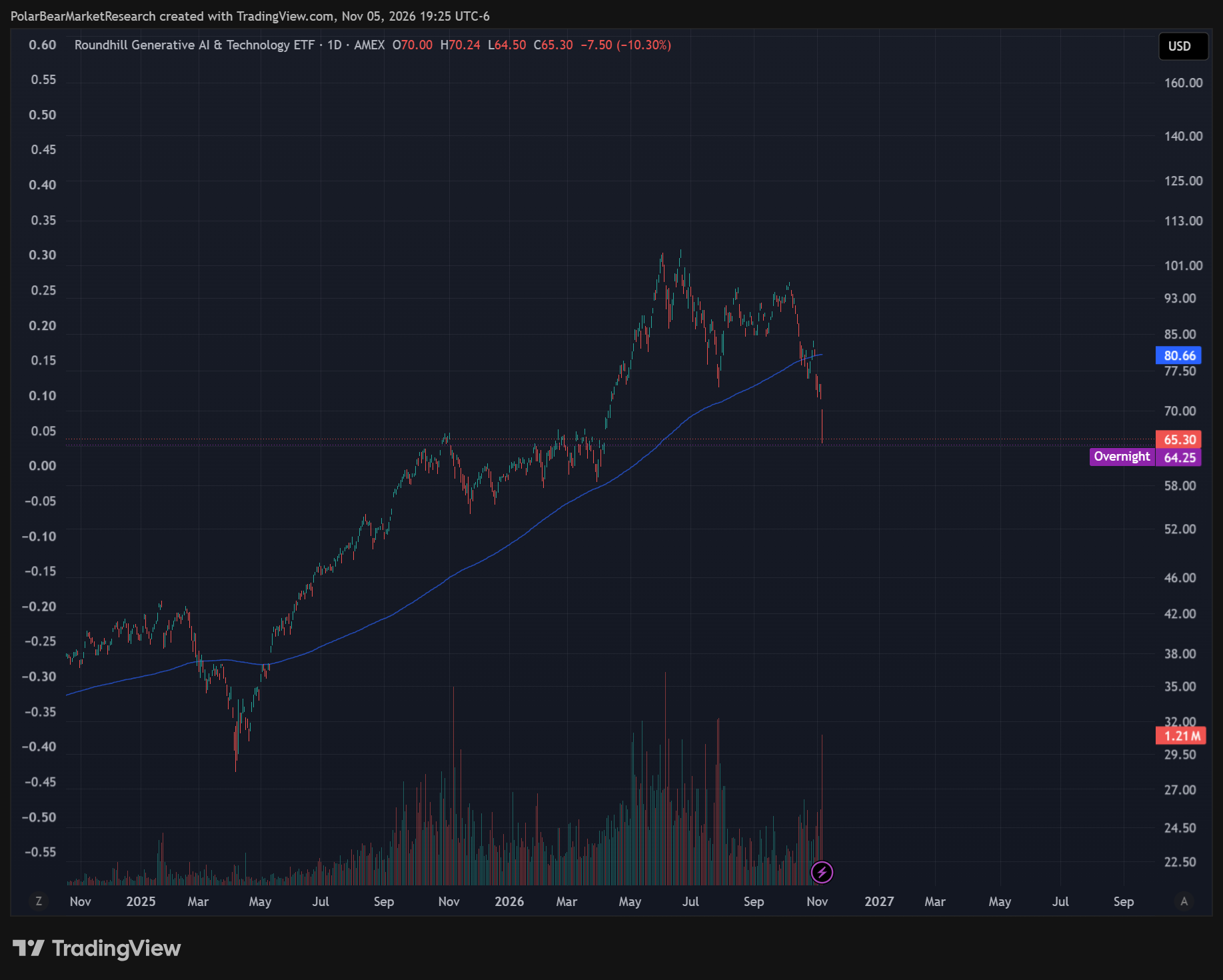
Now - across everything globally - tech, AI, US indices, etc., is not the time to double down into a ‘short the hole’ trap on a short duration. Let’s use our patience that we’ve learned from the oil and gas cycle that goes around and apply it here. Let the MAs catch up, let the bankers wreck retail.
Just look at what they’re doing to retail in Korea:
