

Don Johnson (@DonMiami3), Chief Economist
Good Sunday morning MacroEdge Readers & Community,
Yesterday, we got news (shared by us as well, if you follow our X account @MacroEdgeRes) that the US was conducting strikes against the Maduro regime. Later in the morning, it was announced that a US special forces team had captured Maduro and he was being extradited back to the United States. The mid-morning press conference was even more intriguing, with the President & his top foreign policy advisors, as we heard about potential plans to occupy and run Venezuela for as long as it took to get the desired regime and outcome in place, while revitalizing the oil/energy industry in the country.
Get two week access to MacroEdge Ozone below, and get all of our special report releases below.
Expected Venezuela Outcome
While the focus was on potential ‘boots on the ground’ - this is deeply politically unpopular in the United States, given our track record in the 21st century with such policies. Surgical strikes, coupled with the charges and arrest of a dictator, are politically more… advantageous and don’t run the risk of alienating a % of the base that the party cannot afford to lose going into midterms.
Right now, given the quick strike and extradition, the most likely outcome appears to be a replacement of Maduro with the same (or a similar) regime, and it appears that many members of the regime in power (much like Iran) sold out Maduro in order to retain their power. Right now, the Trump Administration doesn’t have to admit any of this, and will enjoy the temporary benefits of a victory with the public, especially with Latin Americans who have fled socialism/communism, but the press conference this morning didn’t give us much in the way of clues as to who would be running the show. While an installed American government sounds like what they may have been alluding to, it’s easier just to secure rights to the oil and maintain a higher level of control over the current regime in place.
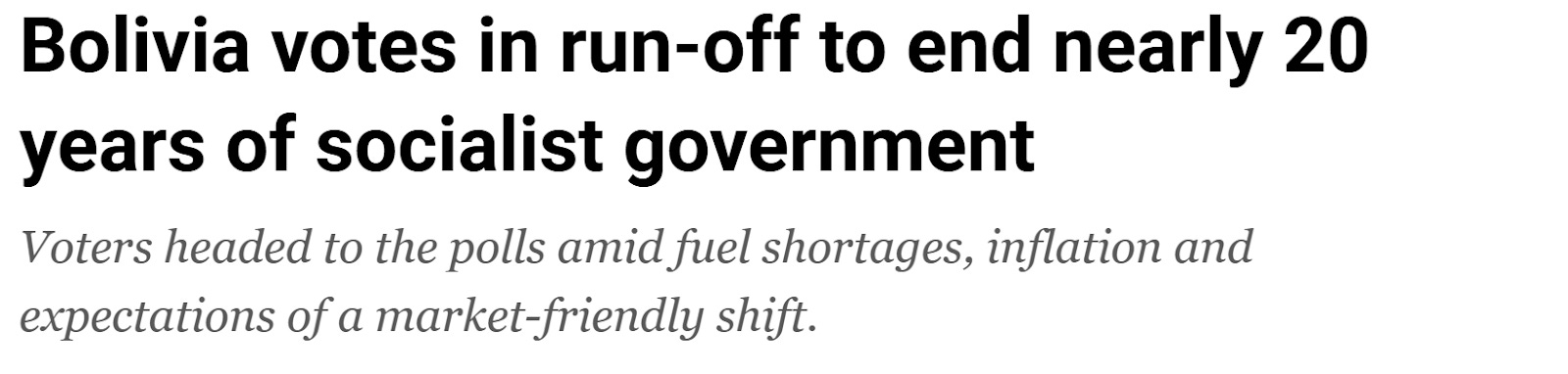
Six does a nice job of highlighting oil opportunities in the country now, which is the most likely sector to ‘open up’ to American opportunity after the military action this morning. We also saw the announcement of a business delegation that will visit the country in March - and if the Chavez-esque leaders wish to retain power, they would be smart to pursue a more open economy and allow more American investment, much like we’re starting to see in other South American countries (like Bolivia).
Shifting South American Dynamics
Note that I’ve excluded friendly small nations like Guyana and focused on larger South American countries below. This Administration, somewhat like we saw with Reagan, explicitly mentioned a ‘Donroe’ doctrine this morning in the press conference, highlighting its desire to flex our might in the Western Hemisphere, as we’ve seen in both Latin America, Canada, and further into South America. Below, I’ve highlighted some of the shifts in South America - now most notably in Chile, Bolivia, and Venezuela:
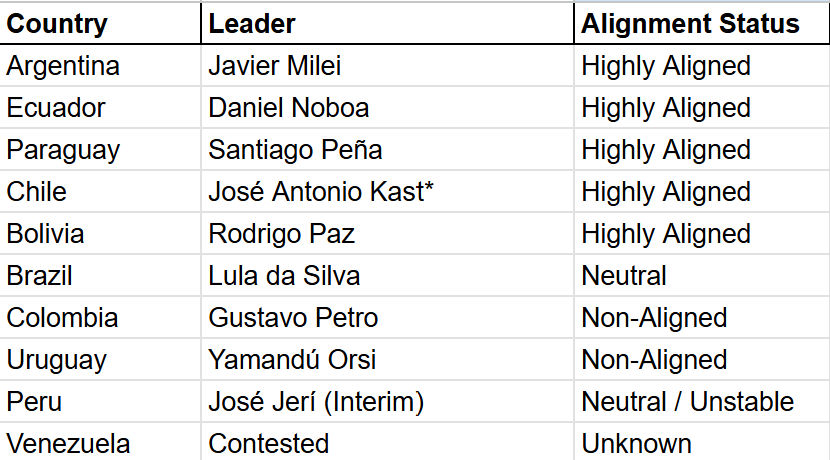
While we have few details on how a new regime in Venezuela will operate, the Administration has pursued a ‘minimize China’ policy for South America, and markets in the continent have responded very positively to a more pro-American stance adopted by particular leaders in the continent.
Subscribe to Ozone through Substack:
South American equity markets have benefited from pro-Trump Administration/USA pivots - and I expect that this theme continues in 2026, as Six highlights below through the energy trade. With Bolivia being the most recent to ‘open up’ to US dollars, not only with tourism but also with foreign investment, I expect that nations that make this pro-Administration pivot will be rewarded positively in 2026 through this stance.
We are likely to see continued positive performance in Peru, Paraguay, and Bolivia - and Venezuela may join this party if they concede some ground in the way of economic liberalization in 2026 - especially through their energy and mining sectors.
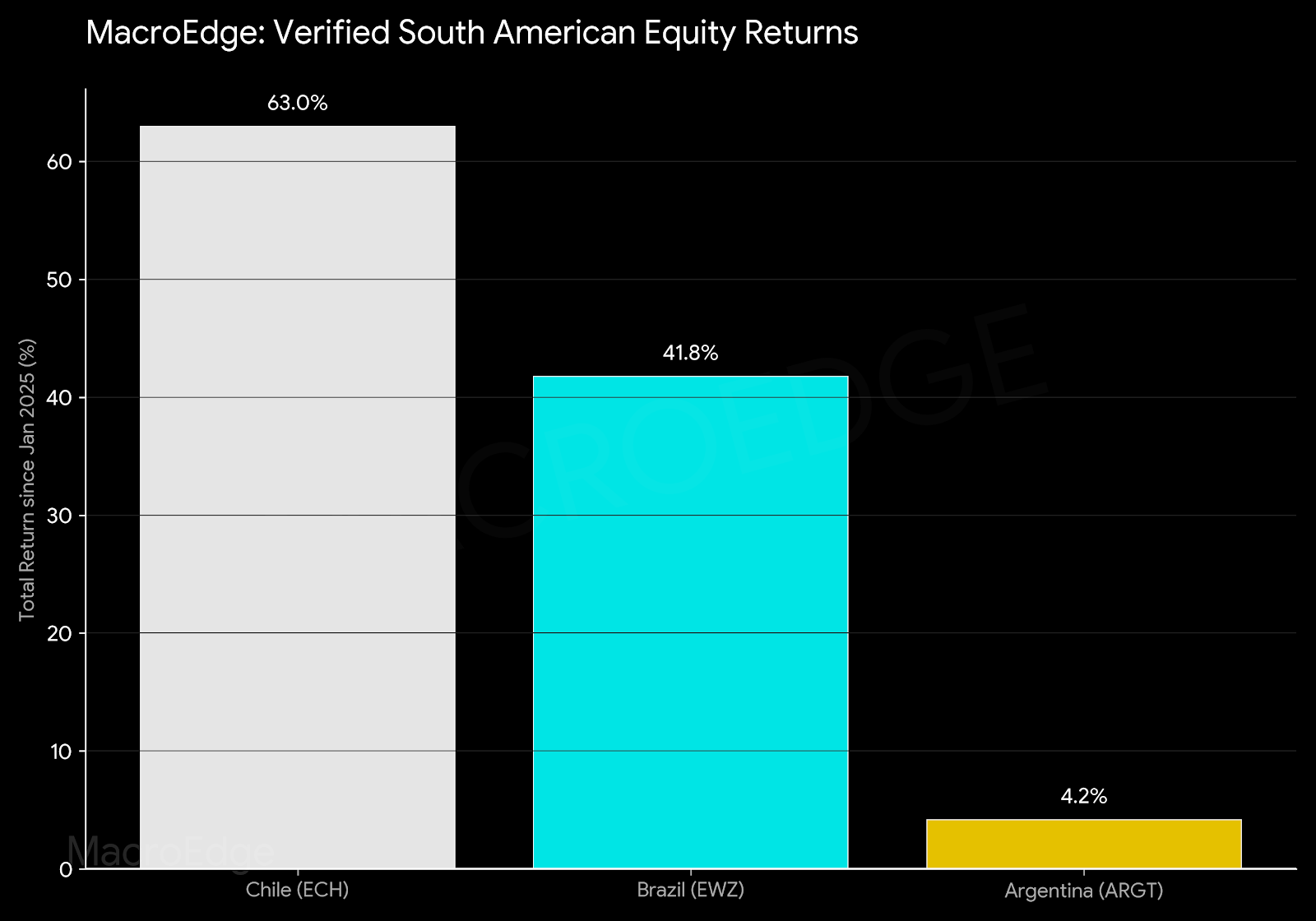
(Above: Chile, Brazil, Argentina) Equity performance since the 1st of January 2025.
Opportunities are on the horizon as the US shift towards more South American intervention are underway, and this means not only public market opportunity - but also private market opportunities for those looking to establish a base in the South American region - especially in these lesser known countries (like Bolivia) that are finally opening up the world and likely present significant opportunity to American firms looking to deploy/move capital elsewhere. South America has tremendous opportunity, and we’ll continue to cover this opportunity as these policies are pursued under the new Administration.

Venezuela’s Coming Oil Boom (@SixFinance, Head of Research)
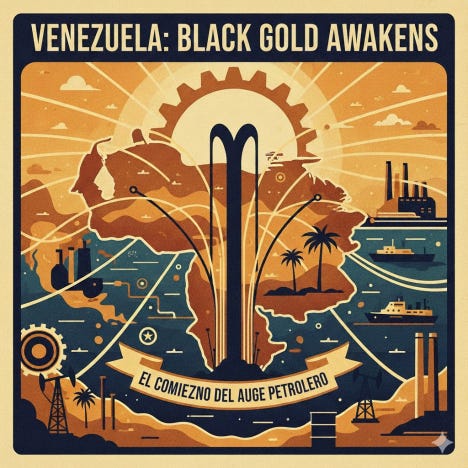
Following Venezuelan President Maduro’s extradition to the US yesterday, the White House has made it abundantly clear that the goal is now to restart the oil industry of the country with the largest oil reserves on the planet.
TRUMP: GOING TO HAVE OUR LARGE US OIL COMPANIES GO INTO VENEZUELA.
Venezuela has seen a large deceleration in barrels of oil produced per day from its peak of 3m+ bpd (barrels per day) to 900k-1m bpd yesterday. After an oil strike in the early 2000s, Hugo Chavez fired thousands of experienced oil engineers, geologists, and operators, and replaced them with political loyalists. The oil industry was optimized for political cash flow, not oilfield health. Cash flow was diverted to social programs. Capex was cut relentlessly. Preventative maintenance stopped. The Venezuelan oil industry never recovered. By the mid 2010s, pipelines were rupturing, refineries ran at fractions of capacity, and power outages routinely shut down field production.
US sanctions in the late 2010s stopped the flow of the dilutants necessary to dilute the heavy crude that Venezuela produces, and forced oil to be sold at steep discounts. By the time sanctions hit, production was already in freefall. Oil worker wages collapsed in
real terms, safety incidents skyrocketed, and qualified experts were few and far between to manage the Venezuelan oil supply chain.
Fast forward to yesterday, and it is clear that the US will send in the oil majors, and revamp the Venezuelan oil industry, in line with the Trump administration’s stated energy policy goals. This creates very unique investment opportunities in the industrial revamp of the largest oil reserves on the planet.
Players:
(Below - opportunities and investments in Venezuela and elsewhere in South America)