…so here we are. March. Fox Business. More partnerships. Airplane seat. I’d be writing this from my laptop if I weren’t sitting in the ‘XL exit aisle’… don’t asked me how that happened on the booking… this cycle is looking a little like 00 and a lot like 07…
The market climbs higher in the face of dismayed shorts, large regional bank stocks plummet, the job market softens, SMCI gets added to the S&P, & the tech casino continues…
I just watched a gal get carried off of the plane this evening as I fly back West, absolutely loathe domestic commercial flying in todays day and age… whole lot of people that should never be allowed on planes. Excuse any typos for this edition given that it’s being written from my mobile.
An interesting note from came in from J this evening - our resident WARN data expert - who noticed that continuing claims were revised lower for the third week of February in California. Given that there were a lot of layoffs the last week of February - it’ll be interesting to see what the impact will be on the final February numbers that will be released in March. The Sahm rule has triggered in roughly half of all states (indicating labor market recession using 50 bps increase from the cycle low):
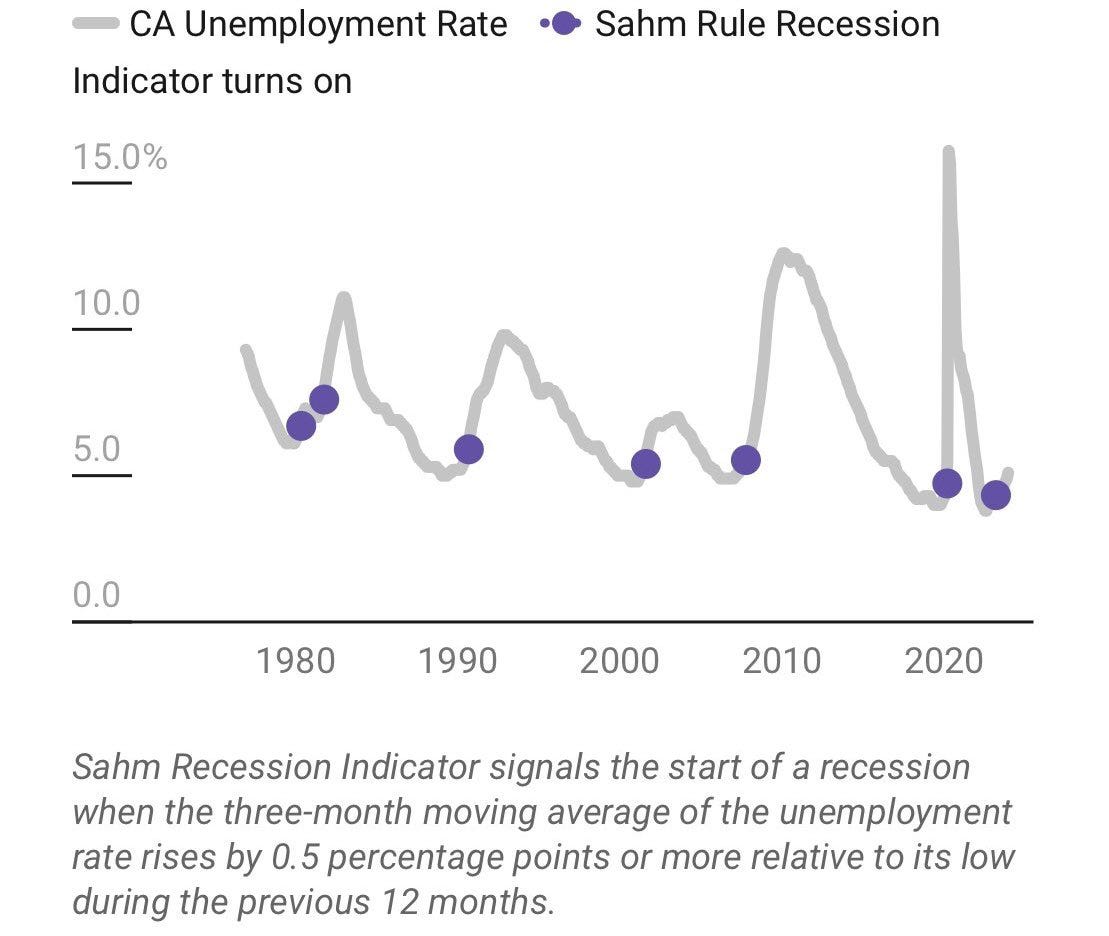
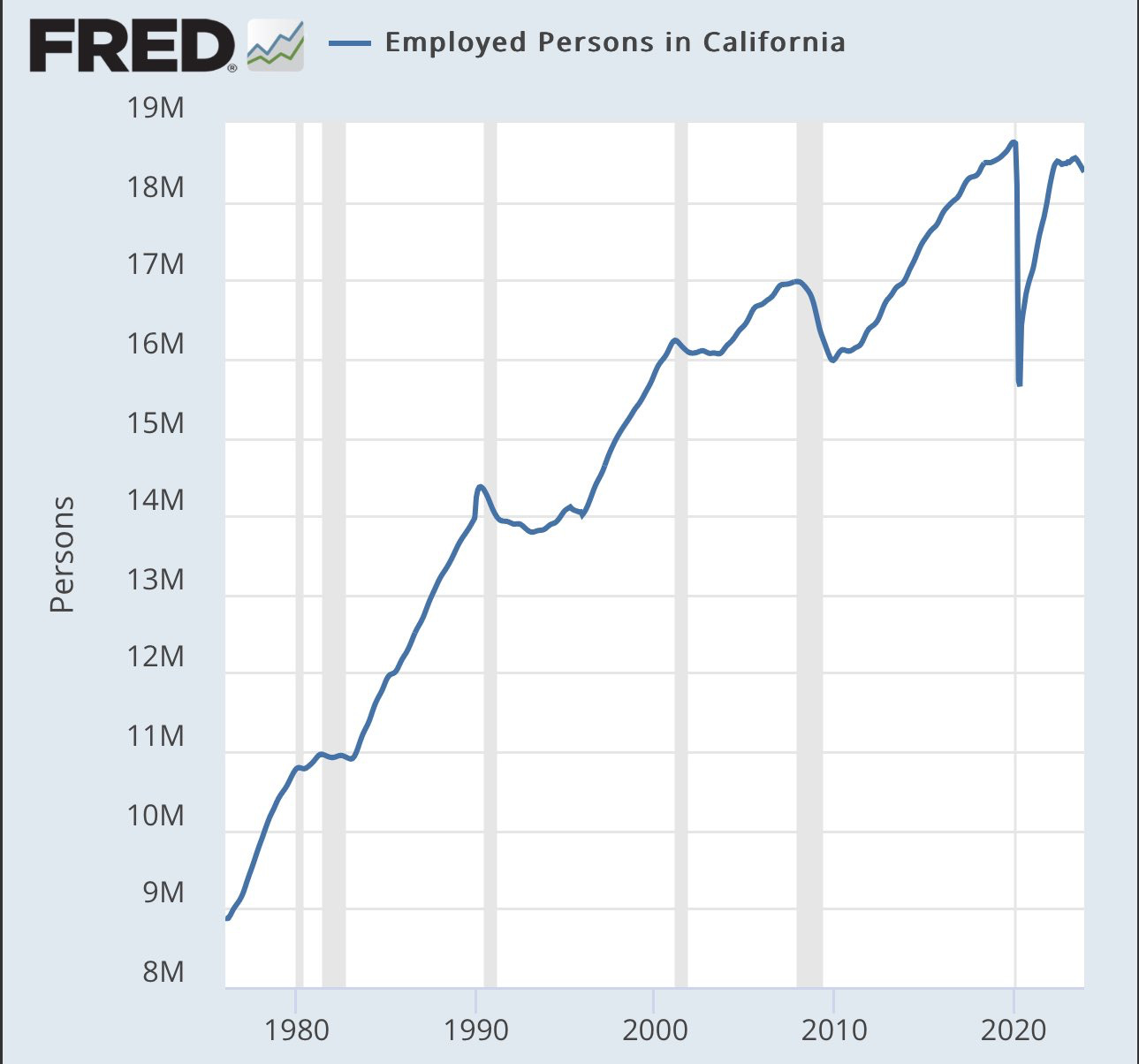
California and other large states like NY continue to flash warning signs for their labor markets… even in the face of the gig economy & individuals choosing gig work over unemployment. The overall ability of the market (Circus Circus Casino) to ignore the job cuts data isn’t surprising, since the labor market hasn’t broken yet to a degree where aggregate demand sends ripples through the larger economy. When this happens, lookout for this casino… My key theme for months 15-25 following 10y3m inversion is labor, labor, labor. Job cuts remained sharply elevated in February although March may be similar or slightly lower depending on cutting plans announced in earnings calls & seasonality starts to kick in acting as a headwind against job cuts. Typical cycle behavior from here on out varies by recession but the labor market weakening is here, it’s just not widespread enough to induce fear.
Our Job Cuts Tracker received a nice feature on Fox Business today - icing on the cake for all of the work this team is putting in:
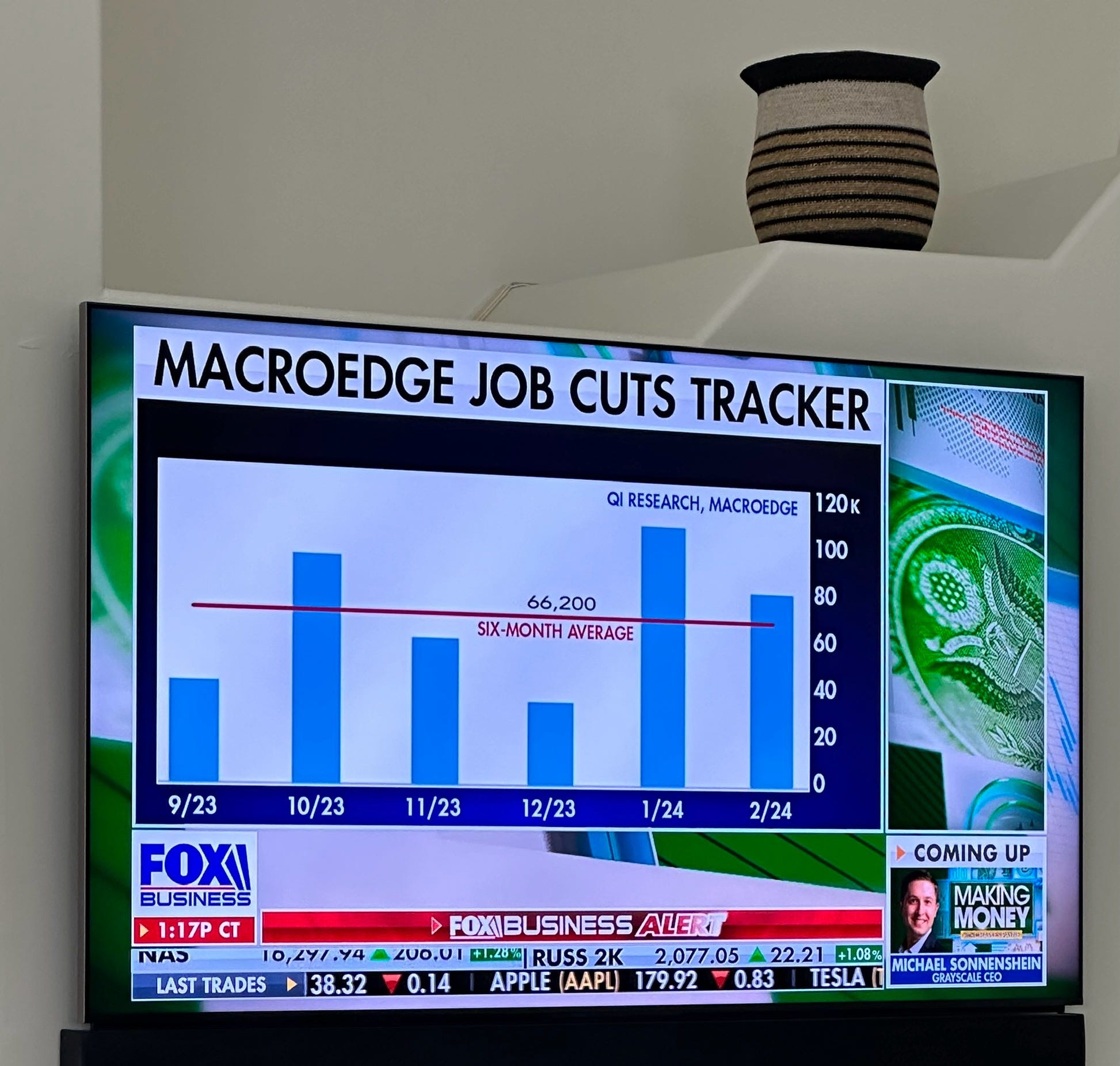
There’s so much data in store for you all from this team that I’m excited to roll it all out when the team on the backend wraps up their substantial task of turning us into one of the premier data providers in the economic research & financial industries.
Construction spending & ISM employment looked weak today - Awsumb & myself discussed this last week in the previous Redeye. When construction employment and spend begins to roll over for the cycle & active multi family builds go over ‘Mt Everest’ as Awsumb referred to it as - residential construction employment is going to be facing massive headwinds (especially in sunbelt states where building remains rampant)… As an economist - or ‘economy meteorologist’ - residential construction employment is hot on my Doppler… that’s all for tonight before my thumbs fall off typing this note from the phone, I hope you all have a wonderful weekend and we’ll see you Sunday evening for the latest Ozone weekly report… Join us there:
Throughout modern American history, there is always the reference to the “forgotten man” as those in power, be it financially or politically punish those poor souls not in a capacity to make impactful decisions which influence the nation’s or their own future.
Yet when the powerful make greed driven and politically erroneous mistakes in violation of their oaths to capitalism and freedom destroy a half generation’s future, those in control blame the errors of the middle class and poor for being submissive to avarice and a willing to achieve the same status of the elites.
Does this sound like an extract from the Communist Manifesto or the writings of the Marxist morons of the early 20th Century?
To this author, I must say no.
Historically speaking, the problem is that the average person’s investing ability is akin to that of the tuber.
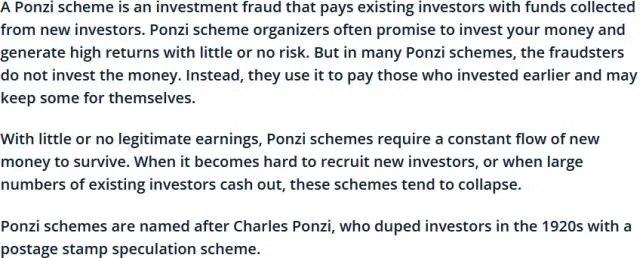
The definition of the phrase “Ponzi Scheme” is a such(from investor.com):

Sounds a little like Pets.com, right? Yeah, this author is showing his age now.
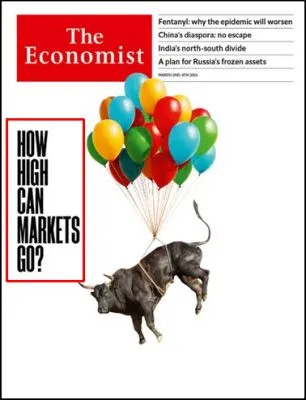
Thus why the bearish view, yes, that is exactly what I am stating about the economic future, in reference to the current status of our “equity” markets while heading into a Presidential election in the West is why the same false Gods of perpetual prosperity are being propped up as they have been throughout modern history.
This author might be the last bear standing, but there is a logical, historical reason as to why.
Throughout every bull market the idea that the terminally stupid will buy the “next great idea” is always around.
In the early 1870’s it was that the insane idealism that railroads would expand forever until people would be able to step to the curb and board a train to work every day and conduct all personal commerce as needed via the trains.
Now let’s quote Jim Cramer on the Panic of 1873:

The summary from the US Treasury is much more succinct:
When Europeans started selling their railroad bonds, there were soon more bonds for sale than anyone wanted. Railroad companies could no longer find anyone who would lend them cash. Many railroads went bankrupt.
One of the biggest banks in New York City was Jay Cooke & Company. It had invested a lot of money in the railroads, and when the railroads started having problems, Jay Cooke & Company went bankrupt. When people saw that such a big bank failed, they began to run to their banks, demanding all of their money back.
The panic spread to banks in Washington, DC, Pennsylvania, New York, Virginia and Georgia, as well as to banks in the Midwest, including those in Indiana, Illinois, and Ohio. Nationwide, at least 100 banks failed.
Does this seem familiar?
As in 2008-2009 familiar?
For the sake of argument, take a moment to refresh on what happened just a bit over fifty years later. The Great Depression of 1920, the one nobody learned in high school or collegiate history classes, was ending and the “Roaring 20’s” ensued.
Technology evolved both due to warfare and global innovation. Radio and automobiles were the rage of the era and everyone had to have both. Competition for the almighty dollar of that era (ahem) created both foreign competition, somewhat restricted like modern day China’s in the American market and among the US manufacturers.
Much like Commodore Computers from the 1990’s, how many of my readers have ever heard of Graham-PaigeMotors?

For the sake of not antagonizing my 105 year old plus readers, let us fast forward to the 1990s, an era I was intimately, along with my 401K sadly Merrilled by.
The boom of the new new new revolution began.
No, not railroads, not radio, not color television or even cable TV. The internet boom was in full swing. I shall never forget the day in 1998 a technician from Time-Warner Cable, then called “Roadrunner” came to our apartment and offered us to be the beta tester for high speed internet cable. Having survived on 24 Kb dial up service for what seemed like forever my wife and I said certainly.
It was then that I realized a new future laid ahead. I piled all of our 401K into internet startups like Netscape, AOL, etc. thinking that the next great revolution was upon us. Having no knowledge of bubbles involving technology at the time, I lost 80% of our retirement because that ML guy said “stay with it, the markets always come back.”
Ahem.
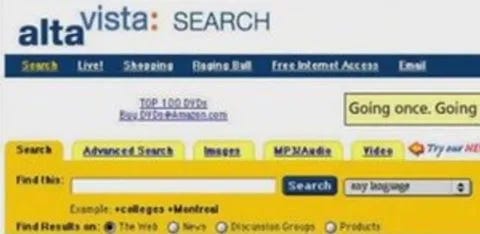
After all, we still use AltaVista for our search engine, right?
With every technological advancement, with every new “evolution” in investing, the media and average man thinks that they have succeeded in outsmarting the “big guys” by following the advice of the propagandists for “the big guys.”
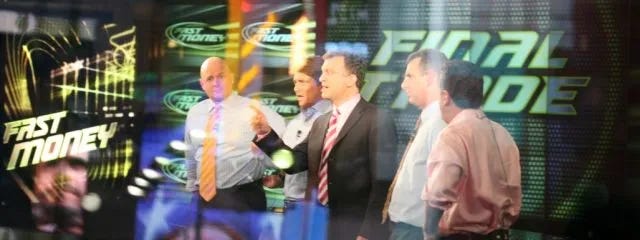
Despite the ascension of faster technology and communications, the newest of media and market pumpers is no different than those of the day of old. Then again, the song does indeed remain the same, even if set to jazz music of the era:
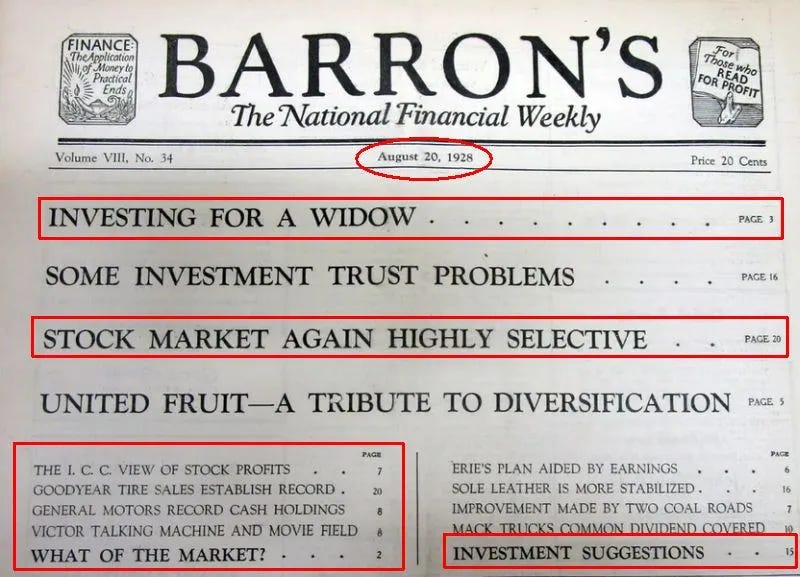
To be honest with my readers, I am more of a historian and technician than a prolific investor. But to state that we are in an unadulterated bull forever market as some media types would profess now is historically ignorant and with our current financial situation, foolish.
The United States and its careless central bank has extended credit to itself, bankrupt nations, bankrupt citizens, bankrupt companies, and foolish endeavors in an attempt to maintain a financial bubble which will prevent a collapse of 1920’s potential.
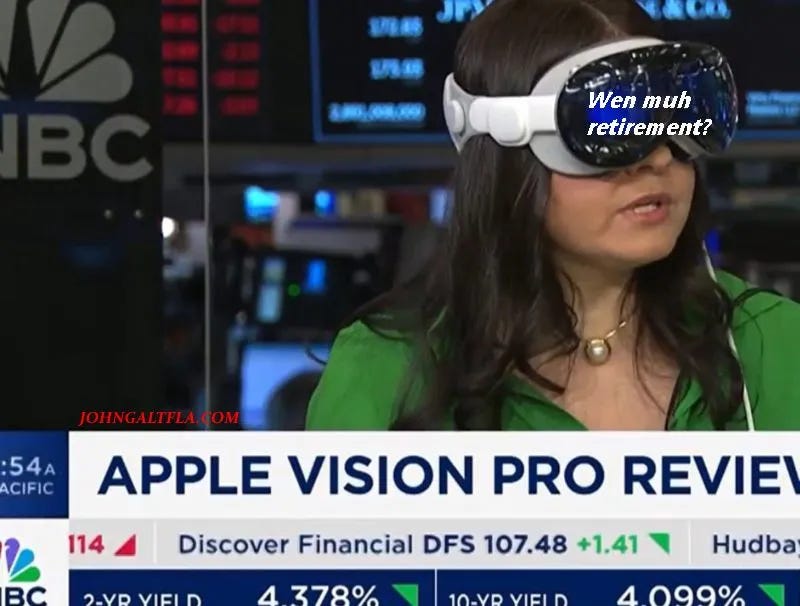
If Apple doesn’t crash like the the Apple TV, Apple Car, and Apple cure for fatness (ok, I’m making that up) then I’ll drink twenty apple martinis.
The reality is that once a tech company reaches its zenith, other companies imagine, create, and surpass them. If one does not believe this could happen, please tell this author how many of his readers are still listening to RCA radios, watching Westinghouse televisions, or using TRS-80 computers?
Apple, Nvidia, and yes, even the beloved Tesla are all susceptible to bigger and better ideas.
In the mean time, if one is nimble enough, enjoy the bull and profit from it. Make one’s money now and get out while ahead.
Bulls make money. Bears make money. Pigs get slaughtered.
Of course if one is logging in via the internet provider below, it might take one some time to realize this.