

Housing Market Update (@DonMiami3, MacroEdge Chief Economist)
Hi all -
Yet another week in the rear view mirror. Markets were mostly mixed this week although we did see Microsoft become the most valuable company in the world (surpassing AAPL). The team is busy getting MacroEdge Ocean ready for release in February: our private social club, a place to network, newsfeed, and more. We are also preparing to move away from the Substack platform and transition all readers over to Ocean at the same time that occurs. More information will be available on this towards the end of the month and a pre-access link will be available then as well.
In today’s report I will be providing an update on the MacroEdge job cuts tracker, an update on the 10m3y spread, a look into housing inventory on both the single and multifamily side, a look at both new home and existing home housing prices, an overview on the multifamily side, a quick glimpse into active units under construction, and provide an overview on the evolving employment situation on the residential construction side. By and large - while our leading employment index based on a basket of 7 cyclical sectors continues to signal warning for the labor market - construction has been one of the most resilient sectors to this point and continues to show growth in sunbelt markets like Nevada which we focus on closely.
Job Cuts:
On the job cuts front - we are seeing an acceleration this month in cuts (like we did last year as well). While cuts are already higher than December, it’s pretty unlikely that we see a higher figure than last January’s Challenger # at >100K job cuts. It would be possible if we see another very substantial cut from a bank on par with Citibank’s announcement that they are reducing their workforce by 20,000 employees. Tech and financial sector employees continue to see the largest impact on the job cuts front and this theme will likely remain through Q1 with elevated rates. We’re seeing the impact…
Full article included in this week’s MacroEdge Weekly Report only available at MacroEdge.net.

Risk Assets Topping (@SixFinance, MacroEdge Head of Research)
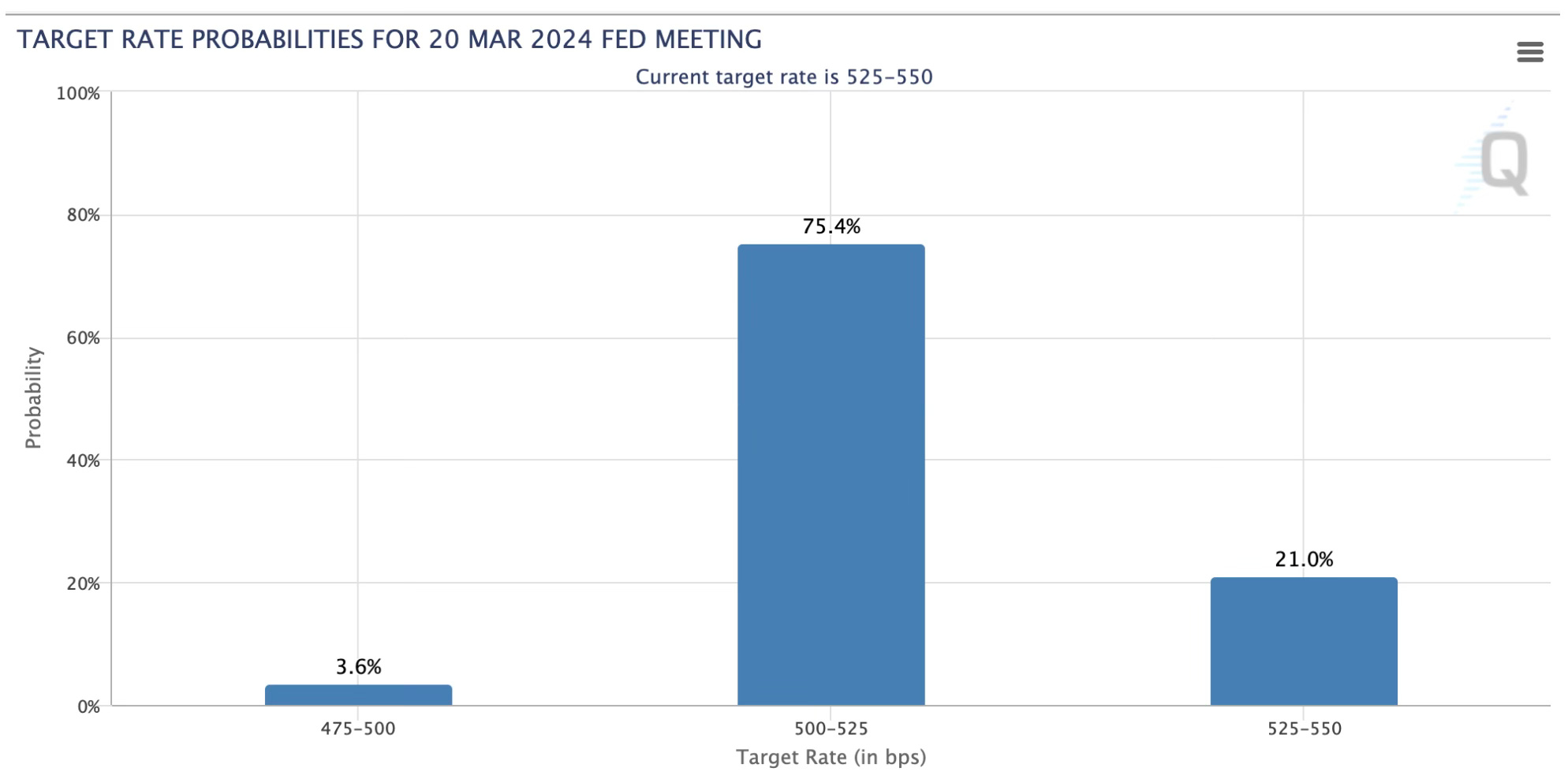
CPI inflation report came in hotter than expected with a reacceleration from 3.1% YoY to 3.4% YoY. Core CPI came in at 3.9% YoY. Despite the hot print, March rate cut odds have now increased in fed funds futures pricing to 75%.
The yield curve inversion has continued to fall dramatically with 10s2s sitting only at -18bps, down from over 1% just a few months ago. Based on the inflation prints, this seems extremely premature, however, with the FED speakers talking about changing the inflation target from 2% to something potentially higher “after” achieving 2% inflation, it shows that they are prepared to let inflation run above trend. However, as multiple FED speakers have pointed out, 3 and 6 month annualized inflation metrics are more favorable currently than year over year data, although it would seem that they are cherry picking data to fit their narrative. It is clear the FED now has a propensity to ease. After all, with the enormous burden of Federal debt, it is going to be very difficult to hold rates at a high level, especially with…
Full article included in this week’s MacroEdge Weekly Report only available at MacroEdge.net.
Decoding the PPI-CPI Tango: Inflation's Silent Dance and the Economic Symphony Ahead (@PeterP91506768, MacroEdge Contributor)
CPI and PPI Relationship
For Friday, everyone’s favorite data point used to proclaim victory against their arch nemesis inflation is the Producer Price Index. Funny enough this index was completely ignored during the inflation-ravaged years of 2021 and 2022. PPI has come in negative month-over-month for two consecutive months, bringing the year-over-year percentage to a seasonally adjusted 1.8%. From a non-seasonally adjusted point of view, the index is down 3.2% YoY…
Full article included in this week’s MacroEdge Weekly Report only available at MacroEdge.net.
America’s Propaganda Economy (@RealJohnGaltFla, MacroEdge Contributor)
The running joke on the American people is that the world they live in is vividly different from the reality presented to them by the financial, media, and political elites.

For example, after the October inflation report, the Reuters headline and story was this: Inflation in the US is improving, the public mood is still sour
The underlying story which is not stated in the article above but is all to obvious is how the elites present the data, which in any normal universe or time line would be called “propaganda.” The idea is that the masses are too stupid to understand just how good the economy is and their beliefs are based on antiquated ideals because Modern Monetary Theory is too difficult for Joe Six-Pack to understand.
However Mr. Six-Pack can understand that egg prices are back above $3.00 per dozen and his beer now costs 5-10% more than it did in December.
If one is to believe the inflation data over the past week, then it is obvious that political not economic motives are the driving factor in the presentation of the reports.
In the links below, I have highlighted some of examples of these stories pushed by the financial, media, and political propaganda machine work together to promote a “narrative” for the ignorant citizenry.
Why Biden gets little credit for a strong US economy – The Financial Times
The economy is improving under Biden. But many voters aren’t giving him credit – The Washington Post
3 Reasons Biden’s Strong Economy Is Unpopular – The New Yorker
So what is the so-called real rate of inflation? If one subscribes to the Atlanta Fed Sticky-CPI indicator (as these pages do) then the reality is that the target is far below the desired level of 2% for the Federal Reserve and indicative that the risk of a repeat of the 1970’s is still present.
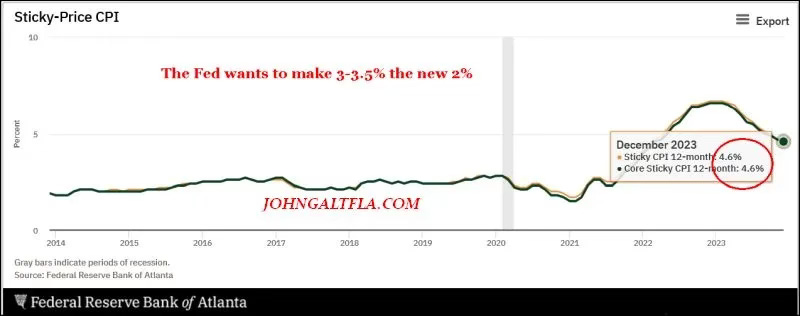
That sure doesn’t feel like what the propaganda says.
he FOMO Show
Another aspect of America’s economic propaganda machine is the constant theory that we all have to improve our lot in live and live like or better than the Jones down the street. They got a minivan, so I have to buy a “luxury” minivan. They added a swimming pool, so I have to buy a boat. Even if my family cannot afford it despite great financing terms.
The idea that the individual has to buy x, y, or z or else they are not “in” at that moment is pervasive in the US consumer based economy and has overlapped now into investing to a degree of insanity reminiscent of the 1920’s.
FOMO, or “fear of missing out” is nothing new. In the 1920’s there was a real estate boom just like 2004-2008 and again, it originated in Florida as the magazine cover below highlights.

That’s right folks, September 14, 1925. Thus what is old is now the “new new” and people had FOMO in the 1920’s also with regards to real estate. But it expanded far past land speculation as the crash in 1929 illustrated.
The Nvidia of the 1920’s was the Radio Corporation of America. If anyone asks the average under 30 investor today what or who RCA was in American history, very “few” would be able to accurately describe the importance of this company and the technological revolution they introduced with affordable radio sets for the majority of American homes, along with the innovations for broadcasting on radio and television in the future.
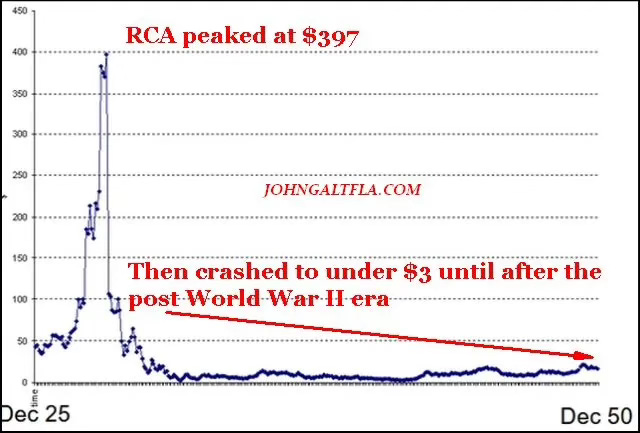
The image above was from a slide presentation, Bubbles and Crashes Dilip Abreu Princeton University Markus K. Brunnermeier Princeton University Hedge Funds and the Technology Bubble.
Thus one has to ask who is not in tune with this era, just what is FOMO and why should I care?
From the National Institute of Health:
“Fear of missing out (FoMO) is a unique term introduced in 2004 to describe a phenomenon observed on social networking sites. FoMO includes two processes; firstly, perception of missing out, followed up with a compulsive behavior to maintain these social connections. We are interested in understanding the complex construct of FoMO and its relations to the need to belong and form stable interpersonal relationships.”
Fear of missing out: A brief overview of origin, theoretical underpinnings and relationship with mental health Mayank Gupta and Aditya Sharma
The emphasis is my own, but highlights how this translates into investing. In fact this week with the issuance of the Bitcoin ETFs, the financial media immediately began promoting their next bubble.
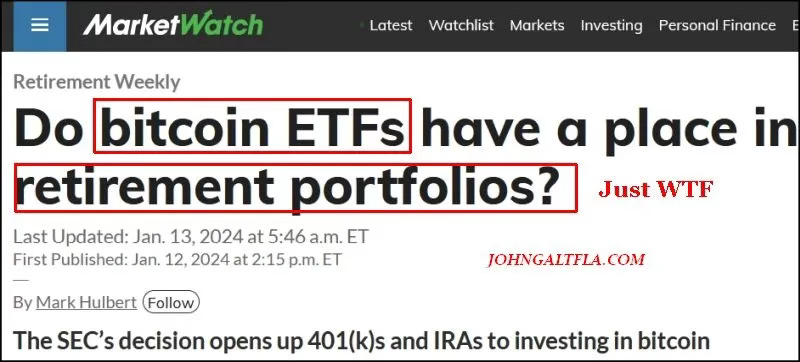
Next up, we’ll be promoting investments in voodoo priestesses and ETFs for compasses made from corn cobs.
The propaganda aspects of this are obvious. If you don’t own x, y, and z in your portfolio, you are a loser and will miss out. If you missed the stock rally because of your broker, portfolio manager, or 401K, you’re a loser and you missed out.
‘FOMO’ creeps into markets as stocks post best month in a year – Yahoo Finance
And if you’re too scared to invest in “Artificial Intelligence” because you do not understand the practical applications according to financial media, then you deserve to miss out.
This will not end well for the masses.
Be Scared When It’s Time to Date TINA
Why would I date someone named Tina? Well the acronym is popular and was made popular by the mainstream media, financial media, etc. during the Trump administration and also the pandemic. If you didn’t get your shots plus four boosters, you missed out. And if you didn’t buy Treasuries in 2021 and 2022, by golly you didn’t pay attention. So who, or what is TINA?
From Investopedia:
“TINA is an acronym for “there is no alternative.”
“It is often used by investors to justify a lackluster performance by stocks on the grounds that other asset classes offer even worse returns.”
“Acceptance of TINA can lead to the “TINA Effect,” a phenomenon in which stocks rise only because investors see no viable alternative place to put their money. In particular, during times when bonds are performing poorly, stocks appear to be the only choice.”
You would not buy a home without getting it inspected and a thorough title check. Lastly you would not send your children to a Doctor with a last name of Mengele.
So why in God’s name does anyone believe anything that is being published in the mainstream now? TINA? FOMO?
Or are we back to the original foundations of our modern economy started in 1913 with financial theory behind the origination of the Federal Reserve:
The greater sucker theory.
