

@DonMiami3, MacroEdge Chief Economist
@SquirtLagurtski, MacroEdge Contributor
A 90s Christmas Redux? ‘Lending Standards v Tech Hype’ (@DonMiami3, MacroEdge Chief Economist)
Hi all & happy Sunday evening -
Huge earnings week ahead. Not much macro talk this evening since much of it was covered in our Thursday report regarding employment. Keep tonight short so I can head to dinner in a few minutes. Don’t forget that you can fill out a form to access our data platform and more come November 5th: macroedge.net. Much appreciate the 50 or so of you who have submitted a form so far. One brief item I want to cover before letting Joe take the floor was lending standards tightening weighing on tech stocks. This relationship will be critical for the next 2 quarters as lending standards are likely to remain very tight over this period of time. (By very tight, I mean >45% of banks are reporting having tighter lending standards in the loan officer survey ‘SLOOS’).
Of note - I continue to watch the NVIDIA darling which was a huge driver propelling markets higher and now we’re starting to see the opposite occur. Nvidia doesn’t report for about a month, on the 15th but other ‘Big 7’ bellwethers this week will give us a potential idea into how Wall St. reacts to earnings.
Here’s some important charts on this:
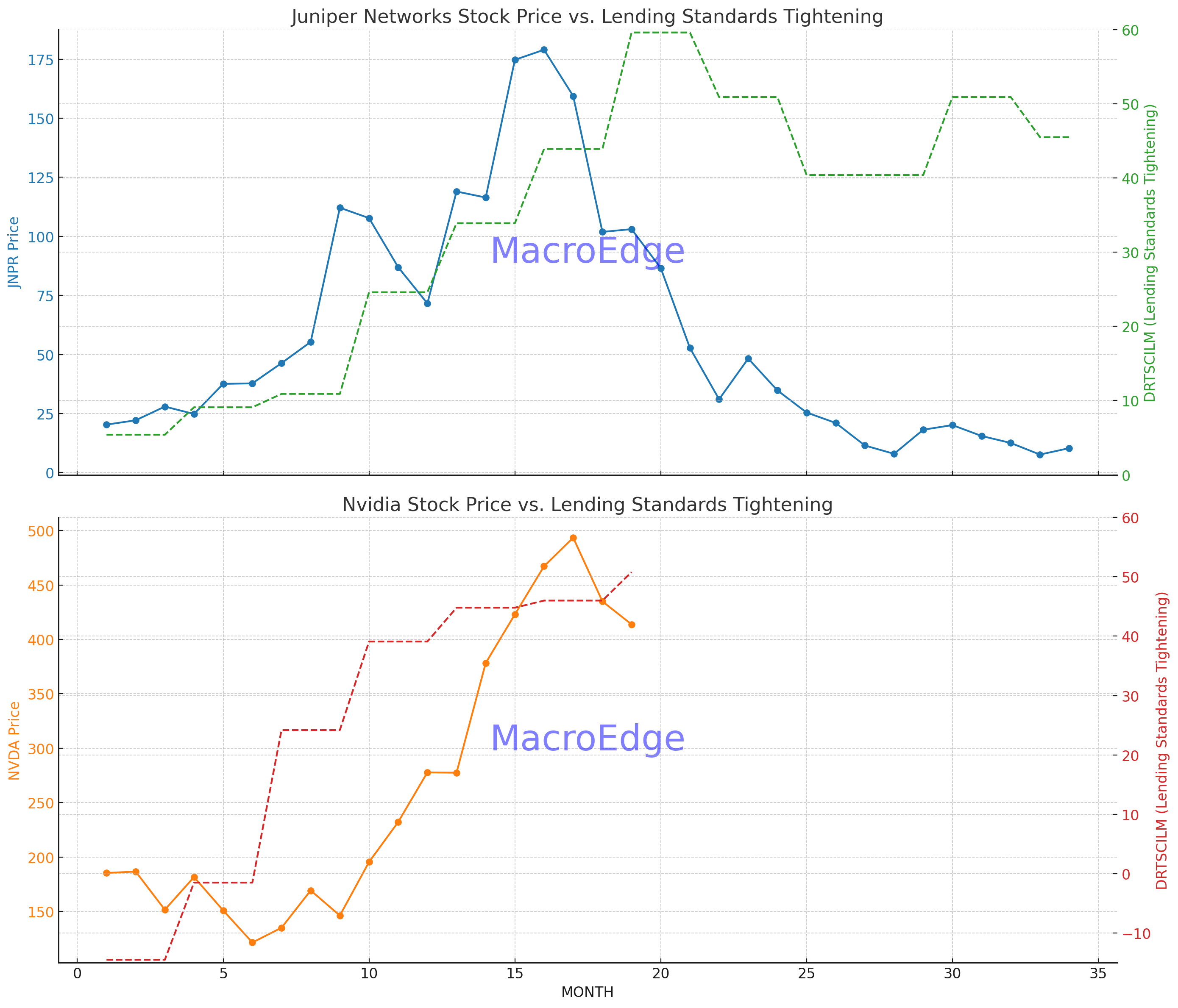
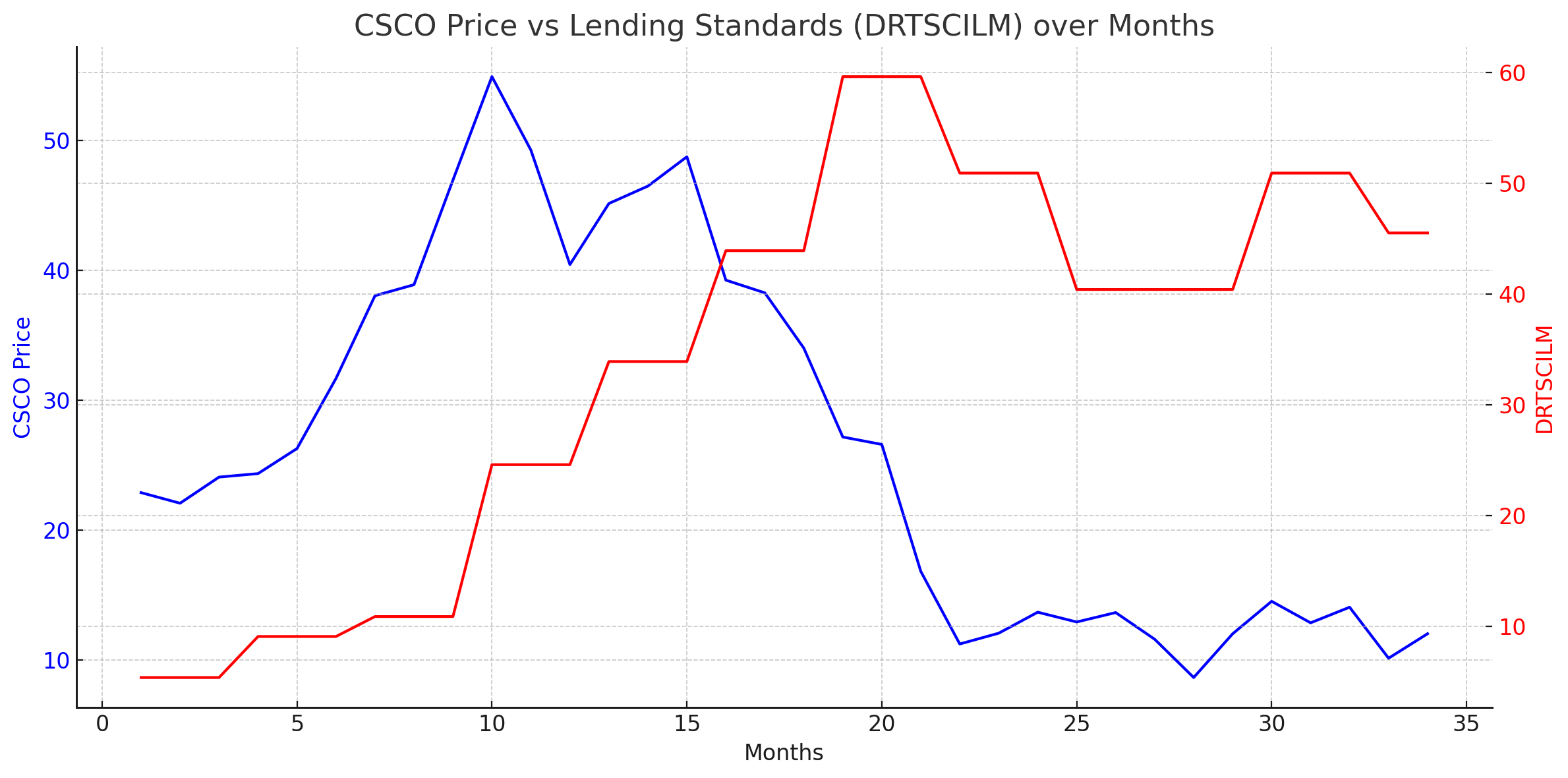
The takeaway: Tech seems to hate tight lending standards!
“The Survey of Loan Officers (SLOOS) provides insights into the lending practices of banks. When there is a 45% threshold on SLOOS, it implies a tightening in lending standards. Tech stocks, in particular, can be more sensitive to such changes. Many emerging tech companies rely on debt and external financing to fund research, development, and expansion efforts. Tighter lending standards can mean that these companies find it more challenging to secure necessary funding. Furthermore, the tech sector, known for its high growth potential, often carries higher valuations based on future earnings expectations. If there's any indication that their growth could be stifled by lack of financing, it can lead to a re-evaluation of these expectations. This re-evaluation can weigh heavily on tech stock prices, leading to potential sell-offs or reduced buying interest in the sector. However, a signal to watch out for is the green light that signals banks giving the all clear on relaxing their lending standards. This could mean that banks are now more willing to lend, potentially leading to a surge in tech financing and a bullish sentiment for tech stocks.” (Bernanke, B. S., & Lown, C. S. (1991). The Credit Crunch. Brookings Papers on Economic Activity, 1991(2), 205-247.)
Let’s keep an eye on the data ahead, along with the GDP print, jobs, & more…
Global Freight Market Update (@SquirtLagurtski, MacroEdge Contributor)
The global freight market has been the source of major speculation in 2023, between various mergers and acquisitions, Yellow Corp bankruptcy, and bobbling spot rates there has been a prolonged imbalance of demand and capacity in every sector of the market. Global ocean freight has seen a rise in blank sailings throughout the year while the largest providers in the sector have taken delivery of their largest capacity vessels, for example MSC added the MSC TESSA in March of this year with over 24,000 TEU costing $600 Million. It is one of 14 new vessels planned to be delivered bringing a total capacity of 1.7 million TEU’s upon their completion. These container ships are LNG powered and will be completed by 2026.
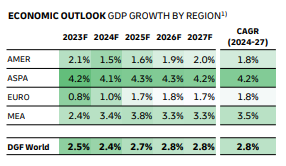
But how is the market sustaining, over the past 12 months MSC among other industry leaders have utilized blank sailings to reduce capacity, the economic GDP outlook for nearly all regions is expected decline going into 2024 followed by gains returning in 2025/2026 except for the Middle East and African regions, and the European region. Asia Pacific and Americas are expected to see decline with the Americas seeing the largest percentage drop between 2023/2024 at .6% and recover more slowly than other regions.
Month after month the global ocean freight market is expected to see little change. Modest gains in the Asia Pacific, North America and Europe are expected to maintain current trends at best, and Latin markets are expected to be mixed. Capacity deployment prior to and after the golden week holiday has been described as “disciplined” due to moderation in activity while the usual golden week rush has been more muted due to already limited demand caused in part by higher inflationary pressures, and rising costs. Blank sailings are projected to increase slightly post-holiday in anticipation for the volatile spot markets to continue their trends. China is increasing their “blankings” mainly due to the continued pressures being forecast, and to stabilize markets (blank sailings are a tactic used to manipulate spot prices by larger carriers to combat volatility). The blankings are more dominant in certain markets such as the East, Mediterranean, and Middle East regions in reaction to previously forecasted weaker demand as market leaders try to sustain rates. Capacity reduction of 30% to 40% per week is estimated, with additional 30% reductions slated for the Middle East alone.
In the Euro/North America regions, rates seem to be stabilizing, with capacity reductions, and fleet deployment adjustments already impacting rates as the regions attempt to balance their own weaker demand with readily available capacity to maximize efficiencies. Inland terminals and ports have been steadily operating with little issue while considering seasonal weather, however it should be noted that most US ports have seen substantial volume reductions in 1H 2023 to the tune of nearly 13.6% from the 2H 2022, and YoY reductions impacting the ports stands at nearly 12.5%. It’s estimated however January 2024 volumes will rise slightly as many target Q1 2024 as an early recovery trend to begin. This outlook is speculation stemming from a forward-looking holiday 2023 season, and as I have stressed in previous articles it may still be too soon to accurately judge how a recovery looks while the global economic picture raises more questions than answers. There is a semi-stable balance currently within the European and North American inland transport capacity, which has been handling reduced volumes well however pressures from a cost basis, demand, and capacity imbalance still effect the regions.
The Panama Canal restrictions have also been forecast to remain in place with the potential for additional measure to be taken, the canal has been under low water restrictions for the entire year due in part to climate change, and persistent drought conditions. There’s little effect however on the market generally as the operators who utilize the canal often schedule well enough in advance. Still, if conditions worsen, further restrictions could lead to carriers needing to transit around the canal adding a week or more to transport times which in turn would affect other, potentially more sensitive cost pressures such as fuel costs. However, it should be noted these types of conditions are often plotted ahead of time. Carriers have been adding Brazilian routes as well with even more forecast for Q4.
The global supply chains during the pandemic saw major shifts in demand and complications due to the dynamics created by a global shut down. Demand for goods exploded during 2020 and 2021 causing an immediate need for carriers to add capacity, however that capacity has quickly diminished even faster than anticipated. Which has left carriers fighting to balance and streamline their operations to improve efficiency while now needing to reduce costs quickly as their balance sheets evaporated late 2022 and throughout 2023 so far. The global economy has come out of the pandemic and consumers have largely been flush with money from stimulus, while also having payments such as student loans paused while ecommerce gathered greater strength. That trend has clearly reversed leaving many US based carriers who were adding large amounts of capacity to handle exponentially higher consumer demand are now struggling to cut back during a time when they also can’t find consistent trends or even regions. As we head into the holiday season there have been several signals in the market alerting economists to a much weaker consumer, and a tougher operating environment for global supply chains. Rebalancing has taken many forms in the US including multiple mergers, bankruptcies, and capacity cuts, and now there has been rift for brokers. All these things point to consumers drastically changing their shopping patterns while also reducing spending. Real conversations have yet to hit mainstream media regarding a slowing of the global economic growth outlook in the next year as well keeping a sort of fearful tone from developing, that may begin to change in the next three months.
The upcoming holiday season is going to be a major signal for a potential recovery being forecast for Q1/Q2 2024 and will provide insights to the strength of consumers who have been under immense pressure already managing rising (and persistent) inflation, housing, new construction costs to manufacturers, a poorly performing Commercial Real Estate sector (this problem has a few implications I will expand on later) and a new hybrid workforce to name a few, all playing a role in any form of recovery, or further slipping of the freight market. The resumption of student loan repayments will be a challenging venture at best to accurately track given the Biden administration is seeking to relieve borrowers and other factors I went into in a previous report. holiday earnings in my opinion will establish a major baseline for 2024 and will have implications within the freight market. The main question is, will it be too late? Will the US and other nations be facing recessions prior to the signals commonly used in the past to see ahead of the curve? All questions which are already partially answered if you’re looking in the right places. I think the freight markets, and global supply chain began to show a higher potential for recession in the months leading into June, and will continue to give multiple insights heading into 2024.
What I am not saying is there will be a sudden, drastic event that will cripple industry. I am saying there are more potential complications in global macro environments for a conversation about recoveries. The Fed and Powell have already signaled they will do whatever it takes to return to 2% and they will base decision making on the “data”. That inherently means their decision making is either lagging or it’s a gamble (if they’re trying to project forward, because if they overtighten it will exaggerate effects to consumers). Personally, I think there’s more than a 65% chance they’re indifferent to consumers in a general sense and at this point they really can’t turn back anyways, so you’re left with a murky freight market, record sovereign and consumer debt, high persistent inflation, very tight labor conditions, strikes (one that could cripple freight and auto), while the federal government is actively engaged in funding two major conflicts. I’m saying buckle up.